CORE TRAINING · STRENGTH AFTER 40
If your core routine still begins and ends with crunches, you are training only a small slice of what your trunk does all day. Lifting groceries from the car, turning to grab a bag and catching yourself on an uneven curb all depend on a core that can hold steady under load.
The most useful core exercises teach the muscles around your trunk to work as a team: bracing, resisting unwanted movement and passing force between your legs and arms. Below are six moves that do that well, with clear form cues and a simple way to fit them into the strength training you already do.
What your core actually does
Mayo Clinic describes the core as the muscles around your trunk, including your pelvis: the lower back, hips and abdominal muscles. Any exercise that uses your stomach and back muscles in a coordinated way counts as core work. Harvard Health Publishing frames it functionally: these are the muscles that help stabilize your trunk so your limbs can move.
That stability shows up everywhere. According to Mayo Clinic, core exercises train these muscles to work in harmony, which leads to better balance and steadiness, and most sports and physical activities depend on a stable core. Weak core muscles can leave you more prone to poor posture, lower back pain and muscle injuries, while strengthening them may help back pain improve and lower the risk of falls. Harvard Health adds that low back pain affects four in five Americans at some point and is a major reason people don’t exercise.
Why crunches fall short
Crunches are not forbidden, but they make a poor centerpiece. Harvard Health explains that sit-ups push your curved spine against the floor and work the hip flexors, muscles that run from the thighs to the lower back. When the hip flexors are too strong or tight, they can tug on the lower spine and create discomfort. Sit-ups also target only a few muscles, while daily life asks many muscles to work together.
Holding positions works differently. Harvard calls planks “the gold standard” for core work because they engage a better balance of muscles on the front, sides and back of the body. The exercises below build on that idea, adding movements that challenge you to resist rotation, keep a level pelvis and stay tall while carrying weight.
Six core exercises worth learning
Several of these come from the core strengthening progression used by Vanderbilt Sports Medicine, and the carries come from Harvard Health. Move slowly, and stop each set while your form is still clean.
- Dead bug. Lie on your back with your knees and arms reaching toward the ceiling. Flatten your back with a gentle pelvic tilt and tighten your stomach, then touch one hand to the opposite knee and switch sides. Keep your pelvis still throughout. As you improve, slowly lower the opposite arm and leg toward the floor instead.
- Bird dog. Start on your hands and knees. Tighten your stomach, then extend one leg behind you while lifting the opposite arm in front, return, and switch sides. Your trunk should stay rigid, as if a glass of water were resting on your lower back.
- Front plank. Rest on your forearms and toes, or on your knees to begin. Harvard’s cues: keep a straight line from head to heels, do not bend at the hips and do not let your belly sag toward the floor.
- Side plank. Lie on your side with your lower forearm under your shoulder. Lift your hips until your legs and upper body form one line. Bend your knees to make it easier; to progress, Vanderbilt adds raising the top arm toward the ceiling or lifting the top leg.
- Suitcase carry. Hold a dumbbell or loaded bag in one hand and walk tall without leaning toward the weight. Harvard suggests walking for 30 to 60 seconds while breathing steadily and keeping your abdominal muscles tensed, resting at least 30 seconds, and completing two to three walks on each side. Holding a weight in each hand turns it into a farmer’s carry, which also builds the grip strength you use every day.
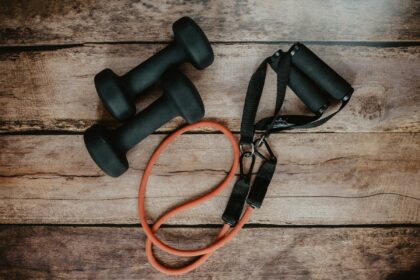
- Band chop. Anchor a resistance band above head height. Stand with your feet shoulder-width apart and knees slightly bent, holding the band in both hands. Tighten your stomach, then pull the band diagonally down and across your body as your trunk turns toward the opposite side. Return with control and work both directions. If you already own bands, our full-body resistance band workout shows how to fit them into a complete session.
A glute bridge makes a gentle warm-up for all six. Mayo Clinic’s cues: keep your back neutral, neither arched nor pressed into the floor, avoid tilting your hips, tighten your stomach before lifting, and hold for three deep breaths without breaking form.
How to fit core exercises into your week
You do not need a separate program. The American College of Sports Medicine’s 2026 resistance training guidelines recommend training all major muscle groups at least twice a week, with 2 to 3 sets per exercise for strength, and they rate bodyweight and elastic band training as highly effective. Choose three of the six moves for each strength session, alternating so you cover all six across the week, and complete 2 to 3 sets of each.
| Exercise | Easier starting point | Next step |
|---|---|---|
| Dead bug | Hand-to-opposite-knee touches | Slowly lower the opposite arm and leg |
| Bird dog | Extend one leg only | Opposite arm and leg, with a pause |
| Front plank | On your knees, a few slow breaths | On your toes, longer holds |
| Side plank | Knees bent | Legs straight, then lift the top arm or leg |
| Suitcase carry | Light weight, 30-second walks | Heavier weight, walks up to 60 seconds |
| Band chop | Light band, small range | Firmer band, fuller turn |
Progress one variable at a time, the same principle that drives any strength plan. Our guide to progressive overload explains how to add challenge gradually. Above all, the ACSM guidelines stress consistency over complexity, so a short routine you repeat beats an elaborate one you skip.
Form cues that keep your back comfortable
- Keep breathing. Brace your midsection as if preparing for a light tap to the stomach, but let your breath move in and out.
- Find neutral. Aim for a spine that is neither arched nor flattened hard into the floor.
- Stand tall under load. During carries, Harvard advises keeping your spine, including your neck, straight, without slouching or leaning.
- Choose the right weight. It should be heavy enough that you must brace to stay steady, but never so heavy that it causes discomfort.
- End sets on good reps. When your hips sag, your back arches or you start to twist, the set is done.
When to check with a professional
Harvard Health recommends checking with your doctor before starting a core program if you have had hip or back surgery or pain, or if you have heart disease or another chronic condition. The same applies if you are pregnant or postpartum, have osteoporosis, or have diabetes or kidney disease and are increasing your training. Pain that travels down a leg, numbness or tingling are reasons to stop and get assessed rather than push through. A physical therapist or qualified trainer can adapt each of these moves to your situation.
TRY IT THIS WEEK
A three-move core session to start with
- Warm up with a few glute bridges, holding each for three deep breaths.
- Do 2 sets of dead bugs, stopping each set while your pelvis stays still.
- Do 2 sets of side planks on each side, knees bent if needed.
- Finish with two suitcase carries on each side, resting between walks.
- Note which side felt harder. Start with that side next time.
SOURCES AND FURTHER READING
Mayo Clinic · Core exercises: Why you should strengthen your core muscles
Harvard Health Publishing · Want a stronger core? Skip the sit-ups · 2023
Harvard Health Publishing · Easy exercises to shore up your core · 2022
Vanderbilt Sports Medicine · Core Strengthening: Phase II
American College of Sports Medicine · 2026 resistance training guidelines update · 2026
This article is for general information and is not a substitute for personal medical advice.
Are you a fitness or wellness professional with a member journey to share?