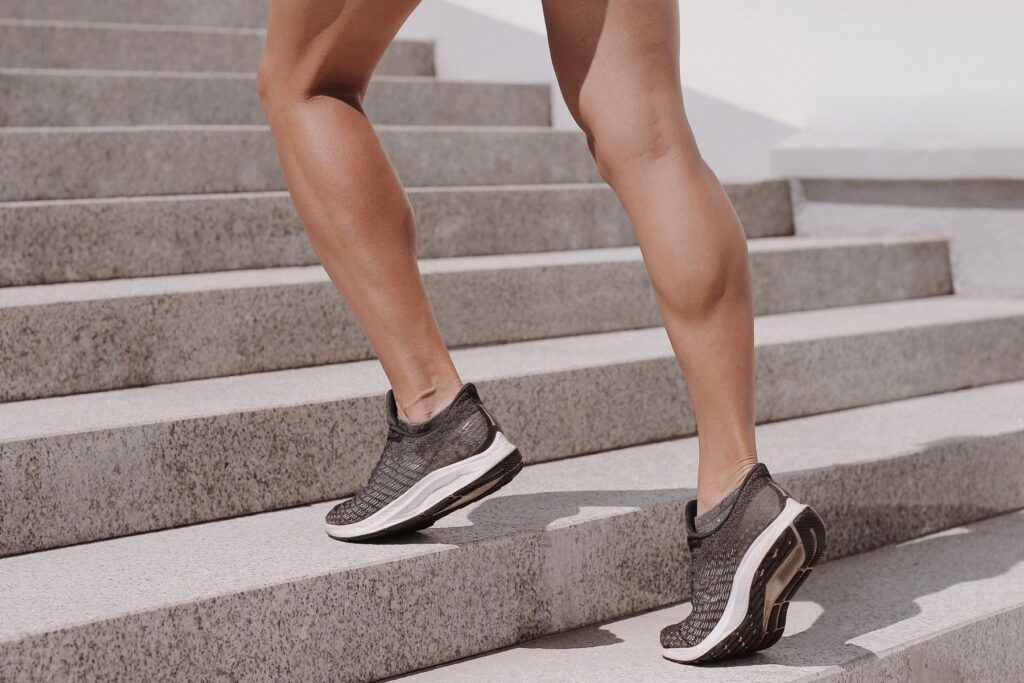
STAIR CLIMBING · ACTIVE LIVING
Most of us treat a staircase as something to get through on the way to somewhere else. Used on purpose, those same steps can raise your fitness a few minutes at a time.
Stair climbing asks your heart, lungs and legs to lift your full body weight against gravity, so even a short climb counts as real effort. This guide covers what the research shows, how stairs compare with other activities, how to climb without aggravating your knees, and a six-week plan you can start on the steps you already have at home, at work or at a local stadium.
Why stair climbing is such efficient exercise
Exercise scientists compare activities using METs, a measure of energy cost in which 1 MET is roughly what your body uses at rest. The 2024 Adult Compendium of Physical Activities puts brisk walking at 3.5 to 3.9 miles per hour at 4.8 METs. Stair climbing at a slow pace comes in at 4.5, and a fast pace taken one step at a time reaches 9.3. So an easy climb costs about as much as a brisk walk, and a fast one costs nearly twice as much.
| Activity | METs |
|---|---|
| Descending stairs | 3.5 |
| Stair climbing, slow pace | 4.5 |
| Walking at 3.5 to 3.9 mph, brisk | 4.8 |
| Stair climbing, general | 6.8 |
| Stair climbing, fast pace, one step at a time | 9.3 |
| Stair treadmill, general | 9.3 |
The work also reaches your legs. Harvard Health notes that climbing works the quadriceps, glutes and calves at once, which makes it a useful bridge between cardio and strength training. Cleveland Clinic adds that stair exercise is weight-bearing and may help bone density, and that it stresses the ankles, knees and hips less than high-intensity running, although joint impact rises as you speed up. If walking is already your base, as in our guide to walking for health, stairs are a natural way to turn up the effort without adding much time.
What the research on stair climbing shows
The largest single study drew on 458,860 adults in the UK Biobank, followed for a median of 12.5 years. Compared with people who reported no daily stair climbing, those who climbed more than five flights a day, about 50 steps according to Tulane University researchers involved in the work, had about a 20 percent lower risk of atherosclerotic cardiovascular disease, the artery disease behind most heart attacks. People who stopped climbing during the study had a 32 percent higher risk than those who never reported it, although illness may be one reason some people stop.
A meta-analysis presented at ESC Preventive Cardiology 2024 pooled nine studies and 480,479 people aged 35 to 84. Stair climbing was linked with a 24 percent lower risk of death from any cause and a 39 percent lower risk of cardiovascular death. These findings are observational and show association rather than proof, because people who climb more may also be healthier to begin with.
Training studies add a cause-and-effect view. Across two McMaster University experiments with 31 sedentary women, three 20-second all-out climbs, three days a week for six weeks, raised peak oxygen uptake by 12 percent. A gentler version, three 60-second bouts up and down a single flight, raised it by 7 percent. Each session took about 10 minutes, including warm-up, cool-down and recovery. The volunteers averaged 24 years old, so the numbers may not carry over exactly to midlife, but the principle does: short, hard efforts add up.
Brief effort woven into daily life shows a similar pattern. In a Nature Medicine study of 25,241 adults who did no formal exercise, with an average age near 62, wearable devices recorded short vigorous bursts of ordinary movement. Three bursts a day, each lasting one to two minutes, were associated with a 38 to 40 percent lower risk of death from any cause or cancer and a 48 to 49 percent lower risk of cardiovascular death, compared with none. A quick climb is one of the easiest ways to get such a burst, which is the thinking behind exercise snacks.
A stair test worth knowing, and its limits
Stairs have also been studied as a rough fitness check. In a study from A Coruña, Spain, 165 patients with symptoms such as chest pain or breathlessness climbed four flights, or 60 stairs, at a brisk pace without stopping or running. Those who needed more than a minute and a half were more likely to show abnormal heart function on treadmill imaging: 58 percent, compared with 32 percent of those who finished in under a minute.
This was a small group of patients already referred for testing, so a stopwatch on your own stairs diagnoses nothing. If stairs have recently started to leave you unusually winded, mention it to your doctor instead of testing yourself.
How to climb with good form and protect your knees
Good stair form is mostly about staying balanced and letting your legs do the work. Harvard Health’s advice for protecting the knee is a sensible starting point.
- Press your whole foot onto the step, rather than only the ball or the heel.
- Keep your hip, knee and ankle lined up, so the knee does not jut forward over your toes.
- Take one step at a time and hold the railing while you learn how the climb feels.
- Keep your eyes up and your phone away. Mayo Clinic warns that distraction on stairs can lead to a fall.
- Come down slowly and with control, especially when your legs are tired.
Stairs are among the activities that stress the knee more than others, and they can be especially painful with more severe arthritis and weak muscles around the joint. If one leg is weaker or sorer, the Arthritis Foundation’s rule is easy to remember: “Go up with the good, down with the bad.” Lead with the stronger leg going up and the weaker leg going down. Our knee exercises can help build the support that stairs demand.
Before you start or intensify stair work, talk with your doctor if you have heart disease, diabetes, kidney disease, new symptoms, an injury or recent surgery, or if you are pregnant. Stop and get medical help if you feel chest pain, faintness or unusual breathlessness. Balance matters too. Mayo Clinic says that if you cannot stand on one leg for 45 seconds without holding on, some harder stair exercises may not be safe for you, and stair hops may be risky with bone loss. Our one-leg balance guide shows how to check.
A six-week stair climbing plan
This plan uses one flight of stairs on three nonconsecutive days a week. Warm up with a few minutes of easy walking, hold the rail, and repeat any week that felt too hard. If you have no stairs nearby, step up and down on a sturdy low step for the same amount of time.
| Week | Main set | How it should feel |
|---|---|---|
| 1 | 4 climbs at a steady pace, walking down and resting 1 minute between climbs | Breathing harder, still able to talk |
| 2 | 6 climbs, with the same rest | Breathing harder, still able to talk |
| 3 | 3 rounds of 1 minute of steady up and down, with 2 minutes of easy walking between | Talking in short sentences |
| 4 | 4 rounds of 1 minute, with the same walking breaks | Talking in short sentences |
| 5 | 3 rounds of 1 minute at a brisk pace, with 2 minutes of easy walking between | Hard, a few words at a time |
| 6 | 4 rounds of 1 minute at a brisk pace, with the same walking breaks | Hard, a few words at a time |
Finish each session with a few minutes of easy walking. If you are new to exercise, there is no need to reach the brisk weeks at all, because even the first week counts.
Stair machines and other ways to progress
Once the plan feels manageable, you have options. A stair machine removes the descent and lets you set the pace. Cleveland Clinic exercise physiologist Katie Lawton says, “You can accomplish a lot in 20 to 30 minutes,” and suggests that newcomers start with about 15 minutes or a lower intensity. Use the side rails for support at first, and choose a pace you can sustain.
You can also turn your stairs into a strength circuit. Mayo Clinic’s stairway exercises include step-ups, stair lunges and side steps, and holding a weight in the opposite hand makes a step-up harder. Mayo also notes that about three minutes of climbing after a meal may help control blood sugar, which makes a flight or two after dinner a useful habit.
YOUR STAIR WEEK
Five easy ways to add flights to an ordinary day
- Walk the first or last few floors of any elevator trip.
- Make separate trips upstairs at home instead of stacking things at the bottom.
- Park near a stairwell at work and start the day with one flight.
- Set a midmorning reminder for a one-minute climb.
- Count your flights for a week, aim to pass five a day, then build from there.
SOURCES AND FURTHER READING
European Society of Cardiology · Climb stairs to live longer · ESC Preventive Cardiology 2024
McMaster University · No time? No gym? No excuse, say Mac researchers
European Society of Cardiology · Test your heart health by climbing stairs · 2020
Adult Compendium of Physical Activities · 2024 activity codes and MET values
Cleveland Clinic · How to use stair-climbers to step up your fitness
Harvard Health Publishing · Master the stairs · 2021
Harvard Health Publishing · Do these activities hurt your knees?
This article is for general information and is not a substitute for personal medical advice.
Are you a fitness or wellness professional with a member journey to share?