



SPEED AND STRENGTH · STRENGTH AFTER 40
Strength helps you lift the suitcase. Power helps you catch yourself when your foot snags on a curb. Over the decades, power tends to slip away faster than strength, and most strength routines never train it directly.
Power training simply means adding speed to resistance exercise: moving a manageable load quickly and with control. It sounds like something reserved for athletes, yet the case for it grows stronger in midlife and beyond, when everyday tasks depend on how fast you can produce force, not only how much. This article explains how power differs from strength, what the newest American College of Sports Medicine guidance recommends, and how to begin safely with movements you probably already know.
Strength and power are not the same thing
Strength is the most force a muscle can produce. Power combines that force with speed. As Harvard Health describes it, power reflects how quickly you can exert force to produce the movement you want. Two people might lift the same weight once, but the one who can lift it quickly has more power.
You use power constantly without noticing. Standing up briskly from a low sofa, taking stairs at a normal clip, stepping quickly to recover after a stumble, crossing a street before the signal changes and hoisting a carry-on into an overhead bin all rely on producing force fast. When power declines, these tasks start to feel slower and less secure, even if you can still technically complete them.
Why power fades faster than strength
According to Harvard Health, muscle power declines at more than twice the rate strength does, by as much as 3.5 percent a year compared with about 1.5 percent for strength. Traditional slow, steady lifting maintains strength well, but it does not specifically train the speed side of the equation, which is why many experienced lifters still lose some quickness over time.
Research also suggests power may say something about long-term health. In a 2025 study in Mayo Clinic Proceedings, Araújo and colleagues followed 3,889 adults aged 46 to 75 for a median of 10.8 years. Muscle power, measured with an upright-row test and adjusted for body weight, was a stronger predictor of death during follow-up than strength measured by handgrip. Like all observational research, it shows an association rather than proof that power training extends life, but it adds weight to the idea that power deserves a place in your plan.
What the 2026 ACSM guidelines say
In March 2026 the American College of Sports Medicine released its first updated resistance training position stand in 17 years, published in Medicine and Science in Sports and Exercise. Led by Stuart Phillips of McMaster University, the authors drew on 137 systematic reviews representing more than 30,000 participants.
The headline advice is to train all major muscle groups at least two days a week and to build gradually. The stand also sets out targets for specific goals, summarized in the ACSM infographic:
| Goal | ACSM 2026 recommendation |
|---|---|
| General training | All major muscle groups, at least 2 days per week, building gradually |
| Strength | Heavier loads, about 80% of your one-repetition maximum, for 2 to 3 sets per exercise |
| Muscle growth | About 10 sets per muscle group each week |
| Power | Moderate loads of 30% to 70% of your one-repetition maximum, lifting as quickly as possible |
Just as useful is the message about simplicity. The authors found that advanced techniques, such as training to failure, particular equipment types and complex periodization, did not consistently change results for the average healthy adult, and that bands, bodyweight and home routines can work well. Their summary: the best program is the one you will actually do.
How to add speed safely
The guiding principle is “strength first, then speed,” as American Council on Exercise expert Sabrena Jo put it to AARP. If you are new to lifting, spend your first several weeks learning each movement slowly with good form. Our guide to your first month of strength training is a good place to begin.
Once a movement feels stable, add speed only to the lifting, or concentric, phase and lower the weight under control. Harvard Health’s classic example is the chair stand: rise from the chair quickly, then sit down again at a normal pace. A few more rules keep power work productive:
- Pick a load you could move many more times than you are asking for. If the weight slows dramatically, it is too heavy for power work.
- Keep sets short, roughly three to six fast repetitions, and end the set when speed or form drops.
- Rest fully between sets, often one to two minutes, so every repetition stays crisp.
- Begin with low-impact options before adding jumps or throws, and keep a wall, counter or chair nearby for balance support.
- Place power exercises early in a session, right after your warm-up, while you are fresh.
Power training is not right for everyone at every moment. If you have heart disease, high blood pressure that is not well controlled, diabetes, kidney disease, osteoporosis, a joint replacement, a recent injury or surgery, or you are pregnant, get clearance from your doctor or a physical therapist first, and consider a few sessions with a qualified coach who can watch your technique.
Five power moves to start with
These exercises use equipment most people have at home or can find in any gym, and each has a gentle entry point.
| Exercise | How to do it | Begin with | Progress to |
|---|---|---|---|
| Fast sit-to-stand | Stand up from a sturdy chair as quickly as you can with control; sit down slowly | Bodyweight, 2 sets of 5 | Holding a dumbbell at your chest |
| Speed push-up | Press away from a wall or counter briskly; lower slowly | Wall, 2 sets of 5 | Bench height, then the floor |
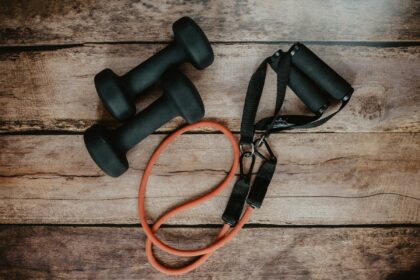
| Band row | Pull a resistance band toward your ribs quickly; return with control | Light band, 2 sets of 6 | Heavier band or cable |
| Medicine ball chest pass | Push a light ball against a sturdy wall and catch it | 2 to 4 pounds, 2 sets of 6 | A slightly heavier ball |
| Step-up drive | Step onto a low box, driving up briskly; step down slowly | Low step, 2 sets of 5 per leg | Higher step or light dumbbells |
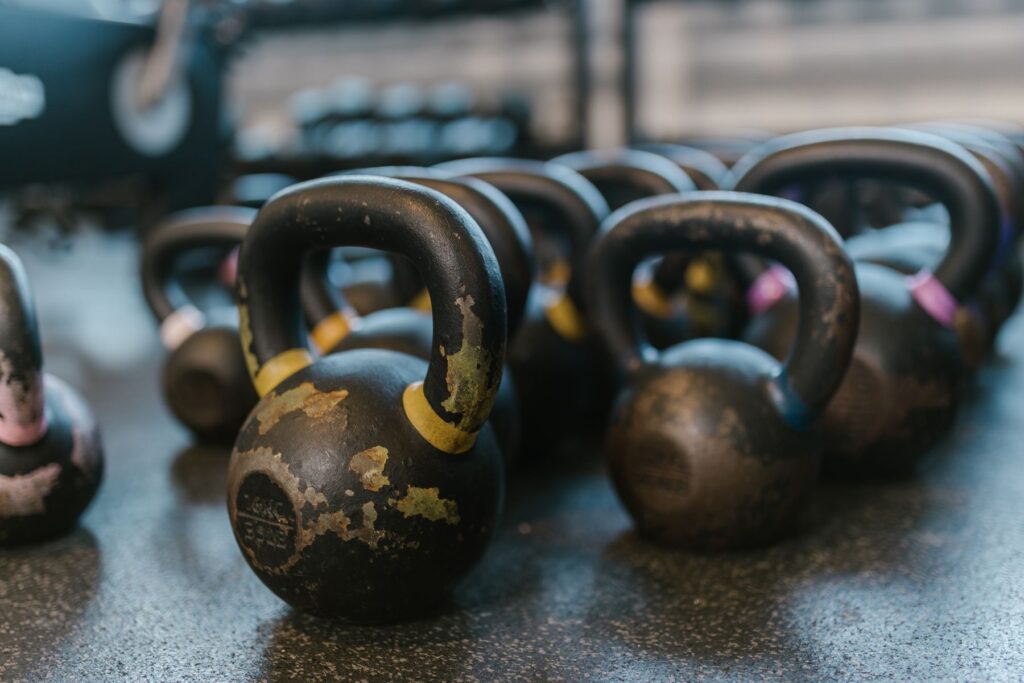
Kettlebell swings are another well-known power exercise, but they demand a solid hip hinge. Learn the kettlebell deadlift first, ideally with coaching, before you try to swing.
Fitting power training into your week
You do not need a separate workout. Add one or two power exercises to the start of your existing strength sessions, then continue with your usual program. Two sessions a week line up neatly with the ACSM minimum, and our guide to fitting two gym visits into a busy week shows one way to organize them. A sample session might run like this:
- Warm-up: five to eight minutes of easy cardio plus a set of bodyweight squats.
- Power: fast sit-to-stands, 3 sets of 5, and band rows, 3 sets of 6.
- Strength: your main lifts, such as squats or leg presses, rows and presses.
- Finish: a short balance drill, such as a supported single-leg stand.
Progress power work gradually, the same way you would any other training. Over weeks you can add a little load, choose a more demanding variation or move from a wall push-up to a bench, always keeping the repetitions fast and clean. The principles in our article on progressive overload apply here too, with one twist: the measure of success is speed you can sustain, not how heavy the weight becomes.
YOUR FIRST POWER SESSION
A 15-minute add-on to try this week
- Warm up for five minutes with brisk marching or easy cycling.
- Fast sit-to-stand: 2 sets of 5, rising quickly and sitting slowly.
- Wall speed push-up: 2 sets of 5.
- Band row: 2 sets of 6 brisk pulls.
- Rest a full minute between sets.
- Note which move felt quickest, then repeat the add-on once more before the week ends.
SOURCES AND FURTHER READING
Harvard Health Publishing · Power training: a complementary approach
Harvard Health Publishing · Power training provides special benefits for muscles and function
American College of Sports Medicine · Resistance Training Position Stand infographic, 2026
AARP · Why power training may be more important than strength training
This article is for general information and is not a substitute for personal medical advice.
Are you a fitness or wellness professional with a member journey to share?