



MAKING FITNESS FIT · STATURE READER GUIDE
Two gym visits can look easy on a calendar until the rest of the week appears around them. The meeting runs late. Someone needs a ride. The drive takes longer than the class itself.
For adults balancing work, family and other responsibilities, the problem is often not finding a more inspiring workout. It is giving the appointment a realistic place to exist. A useful plan accounts for the time around the session as carefully as the session itself.
This guide covers both sides of that problem: how to protect two visits in a crowded week, what those two visits can realistically do for you and how to use 45 minutes well once you are there.
Count the whole appointment
Write down the time you leave, the travel, the visit and the time you are ready for the next part of your day. If a 45-minute class occupies 90 minutes of the schedule, plan for 90.
Compare possible slots using an ordinary week. An early appointment may fit one household and disrupt another. A lunchtime option may work only if changing facilities and travel are straightforward. There is no universal best hour.
The CDC recommends examining how time is used and making activity part of a regular schedule. Its suggestion is to monitor your daily activities for one week and identify at least five 30-minute slots you could use. The practical extension is to include the small transitions that often disappear from an optimistic plan.
Agree on a primary plan and a fallback
Choose the appointments you intend to keep, then ask what happens when one becomes impossible. Can you move a booking? Is there a shorter option? What would your coach suggest for the week if your availability changes?
A fallback should be clear before it is needed. Otherwise a missed appointment creates a fresh decision at exactly the moment you have less time to make one. One simple version is a shortened copy of your usual session, such as a single pair of exercises, rather than a new workout to learn.
Check the booking and cancellation terms. The arrangement should be understandable, including any fees, deadlines and limits on rescheduling. Those details affect whether a plan is workable over more than one enthusiastic week.
What two sessions a week can realistically achieve
Two visits is not a compromise schedule. The American College of Sports Medicine released a new position stand on resistance training in 2026, and its summary of key takeaways names training all major muscle groups at least two days a week as the minimum effective dose. The same summary notes that the largest initial improvements come from starting at all.
Research on frequency points the same way. A 2016 meta-analysis in Sports Medicine by Schoenfeld and colleagues found that training muscle groups twice a week produced better gains in muscle size than training them once. For strength, a 2018 meta-analysis led by Grgic found no significant effect of frequency in studies where total weekly volume was matched.
In other words, the total amount of good-quality work across the week matters more than the number of trips. A 2021 review of time-efficient training by Iversen and colleagues recommends a minimum of four weekly sets per muscle group, using loads in roughly the 6 to 15 repetition-maximum range. Two sessions with two sets per movement reach that mark.
Two sessions are not a shortcut, and a run of missed weeks will still show. Done consistently, though, they give you a realistic structure for building strength in the movements you practice.
A two-day full-body template
Each session below works the whole body. It is built around the multi-joint movements the Iversen review recommends prioritizing, including at least one leg-pressing exercise, one upper-body pull and one upper-body push. Day A and Day B use different versions of each pattern for variety. Place them with at least one full day between, such as Tuesday and Friday.
| Pair | Day A | Day B | Sets × reps |
|---|---|---|---|
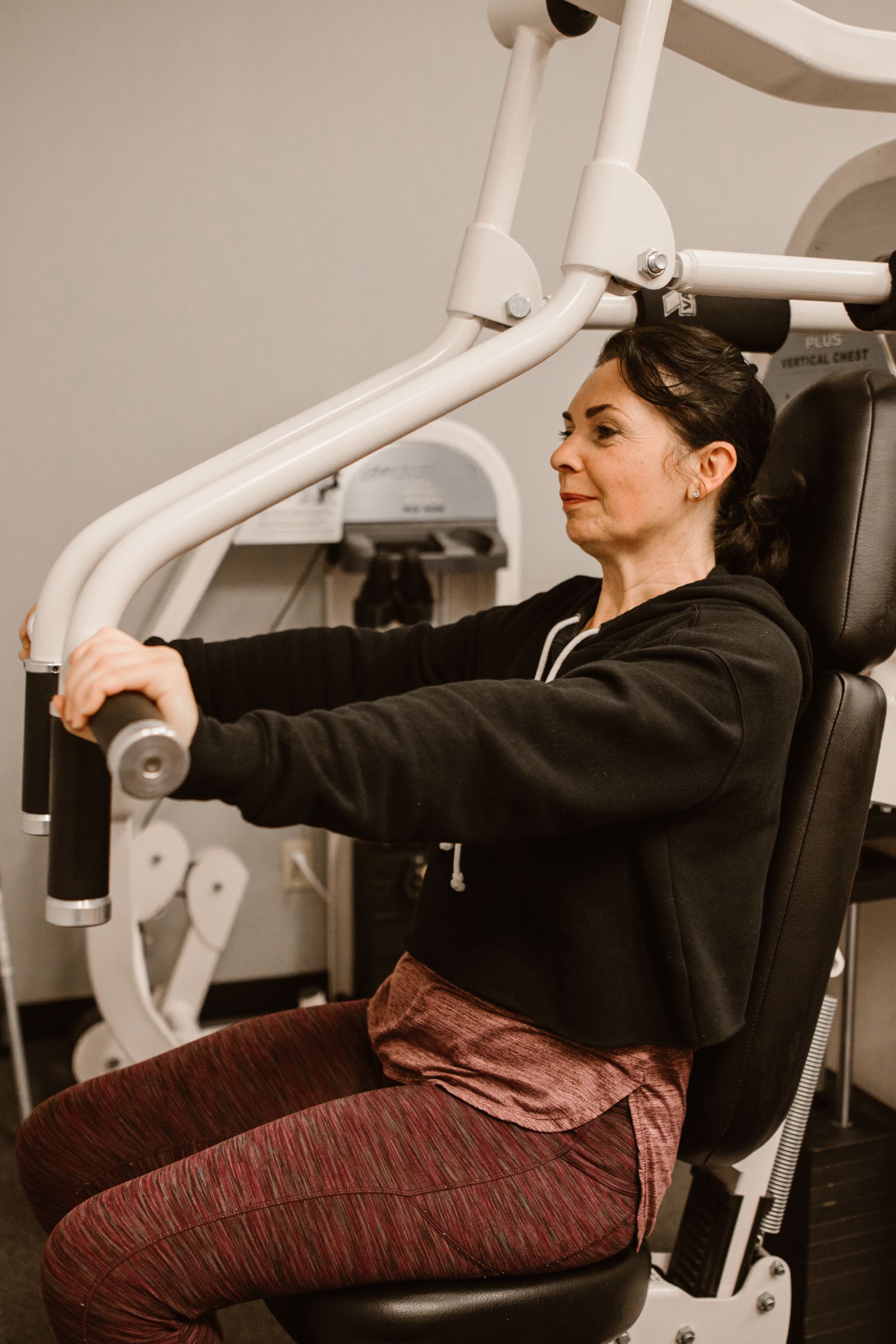
| 1: legs + push | Leg press machine, then chest press machine | Goblet squat to a bench, then incline dumbbell press | 2 × 8–12 each |
| 2: hinge + pull | Dumbbell Romanian deadlift, then seated cable row | Hip bridge, then lat pulldown | 2 × 8–12 each |
| 3: single leg + trunk | Split squat holding support, then suitcase carry | Step-up to a low box, then side plank from the knees | 2 × 8 per side; carry 30–40 steps; plank 20 seconds per side |
Start with loads that let you finish every repetition with steady form, and ask your coach to check your setup on the first few visits. When the top of the range feels comfortable on both sets, that exercise is ready for a small step up.
If a machine is taken, use the other day’s version of the same pattern rather than skipping it. Keeping the pattern in the session matters more than the particular piece of equipment.
Making 45 minutes count
Iversen and colleagues began from a familiar problem: lack of time is among the more commonly reported barriers to sticking with an exercise program. Several of their recommendations translate directly into a 45-minute visit.
- Pair exercises for different muscle groups. Supersets, also called paired sets, are two exercises performed in succession with little or no rest between them. The review reports that techniques such as supersets roughly halve training time compared with traditional sets while maintaining training volume. Alternating a lower-body and an upper-body exercise, as in the template, is a gentle way to start.
- Keep rest periods sensible. Based on most evidence, the authors advise untrained people to schedule rest intervals of 1 to 2 minutes. When exercises are paired, the second movement fills part of that pause.
- Make the warm-up specific. The review suggests restricting the warm-up to exercise-specific preparation, such as a light set of your first movement, and prioritizing stretching only when flexibility is a goal.
- Arrive with the session decided. Writing the plan down beforehand, including last visit’s loads, saves the minutes otherwise spent choosing what comes next.
Put together, a paired session might run like this: about five minutes of light warm-up sets, three pairs at roughly 10 to 12 minutes each and a few minutes to record what you did. That leaves a small margin for a busy gym floor. At peak hours, choosing two stations close together, or a dumbbell exercise you can do beside a machine, keeps the pairing practical.
Keep the rest of the week in view
Two gym visits can provide useful structure, but the number of visits alone does not describe your activity. The CDC’s adult recommendations include both aerobic activity and muscle strengthening, and aerobic minutes can be spread across the week. Our weekly exercise blueprint shows how the two can share a calendar.
Talk with your coach about what the visits contain and what other movement fits your life. A routine built around two appointments should have a clear purpose rather than assume the membership itself completes the picture. The days between visits matter, too, as our piece on making rest days part of your training explains.
Tell the people whose schedules intersect with yours what you are planning. A specific handoff or shared calendar entry is easier to coordinate than a general request for more time.
Review the arrangement after a few weeks
Look at which appointments happened and which did not. Identify repeated friction: the wrong time, an unreliable commute, a class that requires too much preparation or a booking window that does not suit your work.
Look inside the sessions as well. If they regularly run past 45 minutes, the plan may hold one exercise too many for the time you actually have.
Change one practical detail and observe what happens. The question is whether the arrangement becomes easier to use, not whether you can force yourself to tolerate it indefinitely.
A reliable routine can begin with two well-placed appointments. Making room for them is part of the work, and it deserves the same thought as choosing what happens inside them.
This article is for general information and is not a substitute for personal medical advice.
Are you a fitness or wellness professional with a member journey to share?