



SHOULDER HEALTH · STRENGTH AFTER 40
Reaching for a high shelf, lifting a suitcase into the trunk or sleeping comfortably on your side all depend on a small group of muscles most people never train on purpose.
The rotator cuff rarely gets attention until it starts to complain. Yet a few minutes of targeted work, done two or three times a week, can help keep your shoulders strong, mobile and ready for everything else you do in the gym and at home. This guide explains what the rotator cuff does, the signs that call for a medical check first, and a simple set of rotator cuff exercises built on guidance from orthopedic surgeons.
What the rotator cuff does, and why it needs attention
Your shoulder is a ball-and-socket joint built for range rather than stability. The rotator cuff is a group of four muscles, including the supraspinatus, infraspinatus and subscapularis, whose tendons come together to form a covering around the head of the upper arm bone. Those muscles hold the ball centered in its shallow socket while larger muscles, like the deltoids and the back muscles, produce the big movements.
According to the American Academy of Orthopaedic Surgeons, almost 2 million people in the U.S. visit their doctors each year because of rotator cuff tears. People over 40 are at greater risk, and most tears result from a wearing down of the tendon that happens slowly over time. The AAOS also notes that the blood supply to the rotator cuff tendons decreases as we get older, which can make it harder for small injuries to heal, and that repeating the same shoulder motions again and again, as in overhead work or racket sports, adds stress.
Training can’t turn back the calendar, but strengthening the cuff and the muscles that control your shoulder blades keeps the joint working the way it should. Exercise is also central to conservative care: the AAOS reports that nonsurgical treatment relieves pain and improves function in about 80 to 85 percent of patients with rotator cuff tears.
Signs your shoulder needs a professional look first
The routine below is meant for healthy shoulders or for maintenance after a clinician has cleared you. If any of the following sound familiar, see your doctor or a physical therapist before you start:
- Pain at rest or at night, especially when lying on the affected shoulder
- Pain when lifting or lowering your arm
- Weakness when lifting or rotating your arm
- A crackling sensation in the shoulder with certain movements
- Sudden pain and weakness after a fall onto an outstretched arm or a jerking lift
Most of these are symptoms the AAOS lists for rotator cuff tears, and the last describes a common way an acute tear happens. All of them deserve a proper diagnosis rather than guesswork. The same goes for anyone recovering from shoulder surgery, who should follow the program set by their surgeon or therapist.
The core rotator cuff exercises
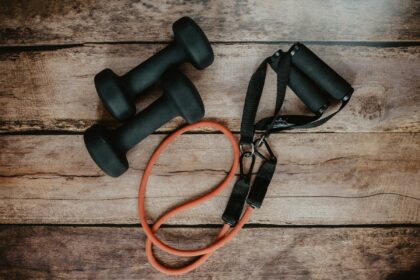
The AAOS rotator cuff and shoulder conditioning program targets the deltoids, the trapezius and rhomboids of the upper back, the teres muscles, the rotator cuff itself and the muscles of the upper arm. The selection below draws on that program and needs only a light resistance band or a light dumbbell. Most of its strengthening exercises are done for 3 sets of 8 or 2 sets of 10 repetitions, three days a week.
| Exercise | Main focus | How to do it |
|---|---|---|
| External rotation (standing, band) | Back of the rotator cuff | Elbow bent to 90 degrees and tucked at your side, rotate your forearm outward against the band, then return slowly |
| Internal rotation (standing, band) | Front of the rotator cuff | Same elbow position, band anchored on the other side, rotate your forearm across your body |
| Side-lying external rotation | Back of the rotator cuff | Lie on your side with a light dumbbell in the top hand, elbow at your side, and rotate the weight toward the ceiling |
| Standing row | Upper back and shoulder blades | Band anchored at waist height, pull your elbows back close to your body while squeezing your shoulder blades together |
| Bent-over horizontal abduction | Rear shoulder and upper back | Hinge forward with a light weight hanging, raise the arm out to the side to shoulder height, then lower slowly |
| Scapula setting | Shoulder blade control | Lying face down, gently draw your shoulder blades down and together, hold, then relax |
Choose resistance so light that the last few repetitions feel like work but your form never changes. The rotator cuff muscles are small, and heavy loads tend to recruit bigger muscles that take over the movement. Move slowly in both directions, keep your shoulders away from your ears, and stop the set if you feel pain rather than muscular effort.
Train the shoulder blades, not just the cuff
The rotator cuff attaches to the shoulder blade, so it can only work as well as the platform underneath it. That is why the AAOS program includes trapezius strengthening, scapular retraction and protraction, and rows alongside the rotation work. When the muscles that steady and move your shoulder blades are strong, your arm has a solid base for pressing, reaching and carrying.
Gentle stretching completes the picture. The AAOS program pairs its strengthening exercises with stretches such as the crossover arm stretch, in which you pull one arm across your chest and hold for 30 seconds, and the sleeper stretch for the back of the shoulder. Warm up first with 5 to 10 minutes of low-impact activity, like walking or riding a stationary bike, do the stretches before your strengthening work, and repeat them at the end.
If you already lift, look at the balance of your program. Plenty of pushing with little pulling leaves the front of the shoulder doing more than its share. The rows and rear-shoulder raises in this routine help even things out, and they fit neatly into a full-body session alongside the exercises in our resistance band workout.
How to fit rotator cuff exercises into your week
The AAOS suggests continuing its conditioning program for 4 to 6 weeks unless your doctor or physical therapist advises otherwise, then performing the exercises 2 to 3 days a week to maintain strength and range of motion. That maintenance dose sits comfortably inside general strength training advice. The American College of Sports Medicine’s 2026 resistance training position stand recommends training all major muscle groups at least twice a week and notes that elastic bands and home-based training are effective options.
Two practical ways to slot the work in:
- As a warm-up. Before an upper-body session, do one or two light sets of external rotation, rows and scapula setting. It takes a few minutes and prepares the joint for pressing and pulling.
- As a short stand-alone circuit. On days you walk or cycle, run through the full table once or twice at home with a band. It makes a useful habit on lighter training days.
If you are newer to lifting, our guide to starting strength training shows how to build these exercises into your first month without doing too much too soon.
Progressing without irritating the joint
Shoulder tendons tend to respond best to patient, gradual loading. Once you can complete every set with smooth control, increase the challenge in small steps: a slightly stronger band, a dumbbell one increment heavier, or a few more repetitions. Our article on progressive overload explains how to make those changes without big jumps.
The AAOS is clear that you should not feel pain during these exercises, and that you should talk to your doctor or physical therapist if you do. Some muscle fatigue is expected; joint pain, pinching at the top of the shoulder or symptoms that linger into the next day are signals to scale back. Check with your doctor before starting a new routine if you have had a shoulder injury or surgery, have heart disease or another chronic condition, or notice new symptoms.
SHOULDER CHECK-IN
A ten-minute starter session for this week
- Walk briskly or ride a stationary bike for five minutes to warm up.
- Hold a crossover arm stretch on each side.
- Do 2 sets of 10 band external rotations on each arm.
- Do 2 sets of 10 standing rows.
- Finish with scapula setting and the crossover stretch once more.
Note which side feels weaker or stiffer. Repeat the session on three days this week, and see your doctor if anything hurts rather than tires.
SOURCES AND FURTHER READING
American Academy of Orthopaedic Surgeons · Rotator Cuff Tears · OrthoInfo
This article is for general information and is not a substitute for personal medical advice.
Are you a fitness or wellness professional with a member journey to share?