



TAI CHI · MOBILITY AND BALANCE
Tai chi can look almost too gentle to matter. The research on balance and falls suggests otherwise, and learning it before you need it gives you years to build a steadier body.
If you have tried a one-leg balance test and wobbled, or you notice you hold the railing more than you used to, tai chi for balance is worth a serious look. This beginner’s guide explains what tai chi involves, what the strongest studies have found, why its slow movements train skills that matter for staying upright, how to choose a class, and how to structure your first 12 weeks so the practice sticks.
What tai chi is, and what it is not
The National Center for Complementary and Integrative Health describes tai chi as a series of slow, gentle movements and physical postures combined with a meditative state of mind and controlled breathing. It began as a martial art in ancient China and has shifted over time toward health promotion and rehabilitation. Harvard Health calls it “meditation in motion”: movements flow in circles, one into the next, without pausing.
Tai chi is not a cardio class or a stretching routine, and you do not need to adopt any of its traditional philosophy to benefit. Think of it as structured practice in moving your body weight smoothly, under control, in every direction. That is exactly the skill that fades when people stop challenging their balance.
What the research says about tai chi for balance
One of the most influential trials, led by Fuzhong Li of the Oregon Research Institute and published in JAMA Internal Medicine in 2018, enrolled 670 community-dwelling adults aged 70 and older in seven Oregon cities. Participants were assigned to a tailored tai chi program called Tai Ji Quan: Moving for Better Balance, to a multimodal exercise program, or to basic stretching. Each group met twice a week for 60 minutes over 24 weeks.
The tai chi group recorded 152 falls, compared with 218 in the multimodal group and 363 in the stretching group. That amounted to a 58 percent lower incidence of falls than stretching and a 31 percent lower rate than the multimodal exercise program.
The broader evidence is more mixed. The NCCIH summary rates the evidence that tai chi reduces the rate of falls in older adults as low certainty, and notes that balance and functional exercise programs in general have stronger support. It also reports that clinical guidelines from the American College of Rheumatology and the Arthritis Foundation strongly recommend tai chi for knee osteoarthritis. The fair conclusion: tai chi is one good way, among several, to train balance, and it suits people who prefer calm, flowing practice over a gym routine.
Most of this research involves people in their 70s, but the logic applies earlier. Harvard Health notes that the benefits of tai chi are greatest if you start before you develop a chronic illness or functional limitations. Learning the form in your 40s or 50s means the skill is already in place when it counts most.
Why slow movement trains a steadier body
Watch a tai chi form closely and you will see a balance workout in disguise. Each sequence asks you to do several things that everyday life rarely practices on purpose:
- Shift weight slowly from one leg to the other, so one leg spends long moments carrying most of your body.
- Step under control forward, backward and sideways, placing the foot before committing weight to it.
- Turn the trunk while the feet stay grounded, linking hips, spine and shoulders.
- Hold a soft, bent-knee stance that works the thigh and hip muscles for minutes at a time.
- Coordinate breath and attention with movement, which many people find calming.
Harvard Health lists lower-body, upper-body and core strength, flexibility and balance among the potential benefits, along with some aerobic effect depending on how fast and how large the movements are. These qualities pair well with the floor-to-standing practice in getting up off the floor and with the stair and uneven-ground skills in feeling steadier on stairs.
How to find a good tai chi class
Tai chi is easiest to learn from a teacher who can correct your stance and pace in person. According to NCCIH, tai chi instructors are not licensed or regulated by the federal government or the states, and there is no national certification standard, so a little homework helps.
- Where to look: Harvard Health suggests local Ys, senior centers and community education programs. Many recreation departments, hospitals and martial arts schools also run classes.
- Ask to watch first. Many teachers let you observe a session before you join.
- Ask about experience and whether the teacher adapts movements for knee, hip or back concerns.
- Start with a short form. Harvard Health recommends short forms of about a dozen movements or fewer for beginners. Yang and Wu are two common styles you will see listed.
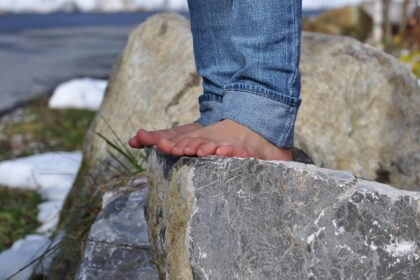
- Dress simply. Wear loose clothing and practice barefoot or in flexible, non-slip shoes with thin soles; Harvard Health notes that running shoes are usually unsuitable.
If no class is nearby, video and streaming classes are a reasonable alternative. Choose a beginner series that breaks each movement down slowly, and practice near a counter or sturdy chair until you feel secure.
Your first 12 weeks of practice
Harvard Health reports that research programs typically last at least 12 weeks, with one or two classes a week plus practice at home, and that positive physical and psychological changes may appear by then. This plan follows that pattern.
| Weeks | Classes | Home practice | Focus |
|---|---|---|---|
| 1–4 | 1 to 2 per week | 10 minutes, 3 days a week | Stance, posture, slow weight shifts and the first few movements |
| 5–8 | 1 to 2 per week | 15 minutes, 4 days a week | Linking movements together and smoother stepping |
| 9–12 | 1 to 2 per week | 15 to 20 minutes, most days | Practicing the short form from memory, slower and lower as control improves |
To see your progress, repeat the simple balance check from our one-leg balance test before you start and again at week 12, standing next to a counter for safety each time.
Practicing safely and making it stick
NCCIH describes tai chi as appearing to be safe, with reported side effects that are mostly minor, such as musculoskeletal aches. Harvard Health advises checking with your doctor first if you have a musculoskeletal problem or take medication that can make you dizzy. Talk with your doctor as well if you have heart disease, diabetes, kidney disease, a recent injury or surgery, or new symptoms such as unexplained dizziness, or if you are pregnant; NCCIH notes there are no published studies on tai chi safety during pregnancy specifically.
Keep your knees soft rather than deeply bent at first, and never push into pain. Tai chi also works best as one part of a full week. The Physical Activity Guidelines for Americans advise older adults to do multicomponent activity that includes balance training as well as aerobic and muscle-strengthening work, so pair your practice with walking and two strength sessions. Finally, anchor it to a routine: the same class each week, the same corner of the living room and the same time of day make the habit almost automatic.
START THIS WEEK
A five-step tai chi starter list
- Search for beginner classes at your local Y, recreation department or community college.
- Call one and ask whether you can observe a session and how the teacher adapts movements.
- Record your one-leg balance time, holding a counter for safety.
- Pick a home-practice slot, such as ten minutes before breakfast, three days a week.
- Mark week 12 on your calendar to retest and decide what comes next.
This article is for general information and is not a substitute for personal medical advice.
Are you a fitness or wellness professional with a member journey to share?