


THE MEMBER EXPERIENCE · STATURE READER GUIDE
Sometimes the difficult part of a first gym visit happens before the workout: finding the entrance, wondering where to put your bag or trying to work out who can help.
At 50, being a beginner can feel especially conspicuous if you are used to being experienced elsewhere in life. Yet the practical questions are the same ones any new member is entitled to ask. A welcoming introduction makes room for them.
What follows is a checklist for the first visit, the unwritten rules of the gym floor in plain terms and a short workout you can repeat until the room starts to feel like yours.
Name the part that feels unfamiliar
“I am nervous about the gym” can contain several different concerns. You may dislike crowded rooms, worry about misunderstanding instructions or feel uncertain about changing facilities. Naming the particular issue gives the staff something concrete to respond to.
It often helps to turn each worry into a plain question. Where do I check in? Is there a quieter time of day? Who shows new members around? A question has an answer; a general sense of unease does not.
Before joining, ask when you can tour the space and whether an introduction is included. A quiet visit may suit one person; another may prefer seeing the gym during the hour they would actually attend. The useful choice is the one that answers your questions.
A checklist for the first visit
Much of the stress of a first visit comes from small unknowns. Settle as many as you can before you walk in, so your attention is free for the people and the space.
- Clothes and shoes. The National Institute of Diabetes and Digestive and Kidney Diseases (NIDDK) suggests clothes made of fabrics that absorb sweat and comfortable, well-fitting shoes with plenty of support. For lifting, Mayo Clinic adds that shoes should protect your feet and provide good traction.
- A small kit. A water bottle, a small towel, a lock if the lockers need one and your membership card or app. Ask ahead which of these the gym provides.
- Your health basics. Know which conditions, recent injuries or medications a coach should be aware of. The American College of Sports Medicine says every adult member should be offered a pre-activity screening, such as the PAR-Q+ questionnaire.
- An orientation request. Among the questions ACSM suggests asking is whether staff give each new member an orientation to the equipment or the facility.
- The emergency basics. ACSM advises that all staff be trained in CPR, AED use and first aid, and that a facility have AEDs on site. Noticing where the nearest one hangs takes seconds.
- Two written questions. Keep them on your phone or a card, so you do not leave still wondering.
Let the staff show you how the place works
An orientation should cover more than a row of machines. Ask how appointments work, who to approach for help and what to do when an exercise station is occupied. If you are taking a class, find out how the instructor identifies newcomers.
The NIDDK also suggests trying a center or class before joining. It also recommends checking what fees cover and understanding membership terms. Familiarity with the arrangement is part of choosing a setting you can use comfortably.
Notice how your questions are received. You do not need a polished sales presentation from the staff, but you do need understandable answers. Being told something twice should not feel like an imposition.
Gym etiquette in plain terms
Every gym has customs that regulars follow without thinking. None of them is complicated, and knowing them in advance removes one more reason to hesitate at the door.
- Wipe it down. Clean the seat, handles and pads when you finish with a machine, using the spray or wipes provided.
- Put it back. Return dumbbells to their place on the rack and take plates off bars and machines. The next person may not be able to lift what you left behind.
- Share the equipment. If someone is resting on a machine you need, ask how many sets they have left or whether you can alternate. Regulars call this “working in,” and a polite request is routine.
- Rest away from busy stations. Checking your phone between sets is fine; doing it while seated on a popular machine at a crowded hour is not.
- Keep walkways clear. Store bags in a locker or cubby rather than on the floor, where they become trip hazards.
- Give lifters room. Leave space around anyone mid-set, and avoid walking directly between a person and the mirror they are using.
- Keep sound to yourself. Headphones are common; phone calls and speaker audio belong outside the training floor.
If you forget one of these, a quick “Sorry, I’m new here” is all the moment requires. Every regular was new once.
Choose a small first-visit objective
For the next visit, decide what would make the room feel a little less mysterious. That could be learning one setup, recognizing the person at reception or knowing where the class begins. These observations are not measures of fitness; they are measures of becoming familiar with the place.
If company would help, ask about bringing a friend or attending an introductory session together. If you would rather have a private explanation, say so. The right amount of social contact is personal, and an outgoing atmosphere is not automatically the right atmosphere for every member.
A simple workout to repeat for three or four weeks
Repetition is the quickest route to familiarity. Rather than trying something new every visit, ask a coach to help you set up one short session and repeat it for three or four weeks. Each visit then asks a little less of you: you know where to start, which seat height to use and what comes next.
The sample below covers the major muscle groups the CDC lists for muscle-strengthening activity: legs, hips, back, chest, abdomen, shoulders and arms. It relies on machines and simple floor exercises because they are easy to learn and adjust. In line with Mayo Clinic’s weight-training advice, warm up with 5 to 10 minutes of brisk walking or other aerobic activity, start with a weight you can lift comfortably 12 to 15 times, and breathe out as you lift.
| Order | Exercise | Amount | What to notice |
|---|---|---|---|
| 1 | Treadmill walk or upright bike | 5–10 minutes, building to brisk | Breathing a little faster, still comfortable |
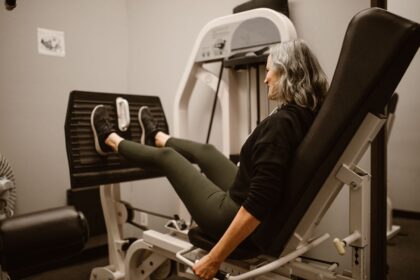
| 2 | Leg press | 1 set of 12–15 | Feet flat on the platform, knees in line with toes, no locking at the top |
| 3 | Chest press machine | 1 set of 12–15 | Handles level with mid-chest; press smoothly, return slowly |
| 4 | Seated row machine | 1 set of 12–15 | Sit tall and draw the elbows back without shrugging |
| 5 | Glute bridge on a mat | 1 set of 10–12 | Press through the heels until shoulders, hips and knees line up |
| 6 | Bird dog on a mat | 6–8 slow reps per side | Reach the opposite arm and leg while keeping the hips level |
| 7 | Easy walk and gentle stretches | About 5 minutes | Breathing settles; nothing feels strained |
Do the session twice a week with a day between, since Mayo Clinic advises against working the same muscles two days in a row. Note each weight and seat setting on your phone. If two visits a week feel hard to schedule, our guide to fitting two gym visits into a busy week can help.
When the last few repetitions of a set feel easy on two visits running, ask a coach about a small increase; our explainer on progressive overload describes what comes after that. Skip any movement that hurts, and mention it to the staff before your next visit.
Judge the welcome, too
After a few visits, consider the relationship as well as the workout. Can you raise a concern? Does the coach remember what you are working toward? Are instructions clear enough to follow without guessing?
You are not auditioning for the gym. You are deciding whether this is a place where you can learn. It is reasonable to compare options if the environment continually leaves you uncomfortable or unheard.
A familiar routine begins with small, repeatable details: an entrance you recognize, a name you remember and an appointment that no longer requires you to solve every part of the visit at once.
A QUESTION WORTH ASKING
“How do you help someone on their first three visits?”
Listen for a clear introduction, a named point of contact, an orientation to the equipment and time for questions.
This article is for general information and is not a substitute for personal medical advice.
Are you a fitness or wellness professional with a member journey to share?