

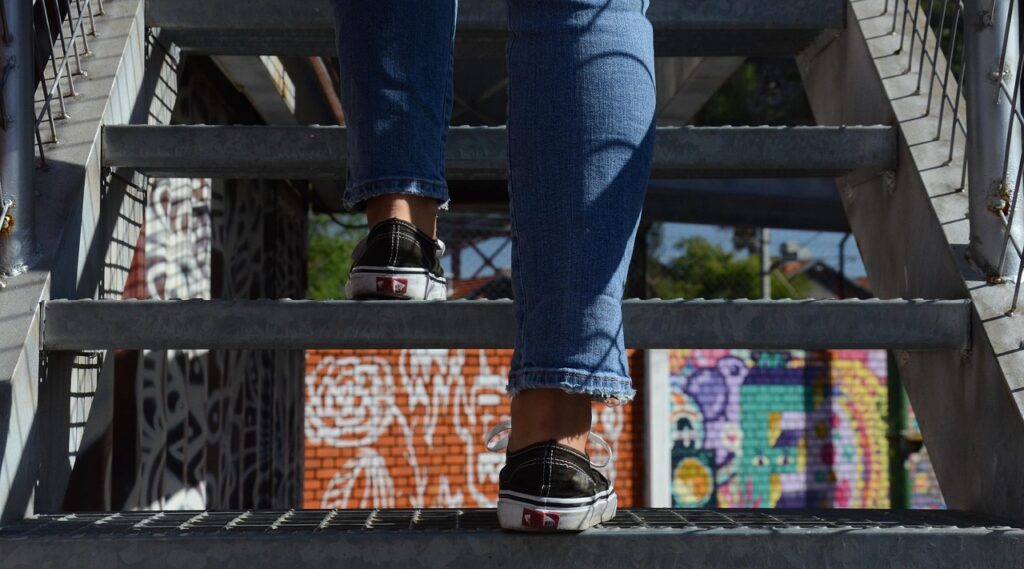
SINGLE-LEG TRAINING · STRENGTH AFTER 40
Every stair you climb, every curb you step down from and every trail you hike asks one leg at a time to carry you. If your strength work always has both feet planted side by side, part of that job never gets trained.
Single-leg exercises such as split squats, step-ups and lunges fill that gap. This guide explains what the research says about training one leg at a time, which moves to learn first, how to progress them safely and how to fit them into the strength routine you already have. You need little more than a sturdy step, a wall to hold and, eventually, a pair of dumbbells.
Why Single-Leg Exercises Matter in Daily Life
Walking, climbing and changing direction are all built from moments when one leg supports you while the other moves. Single-leg exercises train strength in that same position, asking the muscles around your hip, knee and ankle to work together while you stay balanced. Each side has to carry its own load, so a stronger leg cannot quietly cover for a weaker one.
That mix of strength and steadiness is why clinicians like these moves. A Harvard Health report on step-ups noted that falls remain a significant cause of fatal injury among older adults and that practicing simple step-ups at home or in the gym can improve balance, lower-body strength and confidence. For readers in midlife, the payoff shows up both now, in easier hikes and stairs, and in the decades ahead. If stairs and uneven ground already feel shaky, our guide to feeling steadier on stairs and uneven ground pairs well with this one.
What Research Says About Single-Leg Exercises
Is single-leg training better than two-leg lifts like the squat or leg press? The best current answer is that each builds the kind of strength it practices. A 2025 systematic review and meta-analysis in Sports Medicine by Kassiano and colleagues pooled nine studies comparing unilateral and bilateral resistance training. Unilateral training produced larger gains in single-leg strength, bilateral training produced larger gains in two-leg strength, and the review found no significant difference in muscle growth between the two approaches. In the authors’ words, strength gains appear to follow the principle of specificity.
That points to a practical middle ground. Keep a two-leg lift such as the goblet squat in your routine for heavier loading, and add single-leg work so you are also strong in the positions you use on stairs, slopes and trails.
The American College of Sports Medicine’s 2026 position stand on resistance training, an overview of 137 systematic reviews, adds useful context. It recommends training all major muscle groups at least twice a week and found that the type of equipment, whether machines or free weights, did not consistently change results for healthy adults. Bands, bodyweight and home routines also produced marked benefits, which makes single-leg training easy to do almost anywhere.
Five Single-Leg Moves to Learn First
Learn these roughly in order, from most stable to most demanding. Hold a wall, rail or sturdy chair at first if you need to; support does not make an exercise less useful, and it lets you focus on the leg doing the work.
- Split squat. Stand in a long stride with both feet pointing forward and your back heel lifted. Lower straight down until your back knee hovers above the floor, then press through your front foot to rise. Your feet stay put, which makes this the easiest place to start.
- Step-up. Place one whole foot on a sturdy step or low box. Lean slightly forward and drive through that foot to stand tall, then lower yourself slowly. Begin with a step about the height of a stair and let the top leg do the work rather than bouncing off the bottom foot.
- Reverse lunge. From standing, step one foot back and lower into a split squat, then push back up to the start. Stepping backward is usually gentler on the knees than stepping forward.
- Single-leg Romanian deadlift. Holding a support, hinge forward from one hip as your free leg reaches back, keeping your back long, then stand tall again. This trains the back of the hip and your balance together; our guide to the hip hinge covers the movement pattern.
- Lateral lunge. Step out to the side and sit back into that hip while the other leg stays nearly straight, then push back to the center. Side-to-side strength helps with the sudden shifts that uneven ground demands.
A Progression From Supported to Loaded
Progress one change at a time: first range of motion, then repetitions, then load. When you can complete all your sets with good control and a couple of repetitions left in reserve, move one step down the table. Take a week or two at each stage; there is no prize for rushing.
| Stage | What it looks like | Starting target |
|---|---|---|
| 1 | Split squat or step-up while holding a support | 2 sets of 6 to 8 per leg |
| 2 | The same exercises, hands free | 2 to 3 sets of 8 to 10 per leg |
| 3 | Dumbbells held at your sides | 2 to 3 sets of 8 to 12 per leg |
| 4 | Weighted reverse lunges and single-leg Romanian deadlifts | 2 to 3 sets of 6 to 10 per leg |
| 5 | Rear-foot-elevated split squat or a higher step | 2 to 3 sets of 6 to 10 per leg |
Treat these numbers as starting points, not rules. The ACSM review found that training to complete muscle failure did not consistently improve outcomes for healthy adults, so stopping a repetition or two short of failure is fine. For the broader principle of adding challenge over time, see our guide to progressive overload.
How to Fit Single-Leg Work Into Your Week
You do not need a separate leg day. In each of your two or three weekly strength sessions, include one single-leg exercise alongside your other lifts. Rotate them across the week, for example split squats on Monday and step-ups on Thursday, so you practice more than one pattern.
Work your weaker or less coordinated side first, then match its repetitions on the stronger side. Over a few weeks, the gap between sides often narrows. Doing these moves early in a session, while you are fresh, also makes it easier to keep good form and balance.
Single-leg work can double as balance practice. Pausing for a second at the top of a step-up or slowing the lowering phase of a reverse lunge adds a control challenge without adding any weight.
Common Mistakes and Knee-Friendly Fixes
- Knee caving inward. Keep your front knee tracking roughly over the middle of your foot. Lighten the load or hold a support until you can.
- Pushing off the back foot on step-ups. Lift the toes of your trailing foot slightly so the top leg has to do the lifting.
- A stance that is too narrow. Keep your feet about hip-width apart side to side, as if standing on two rails rather than a tightrope.
- Rushing the way down. Take two or three seconds to lower yourself; much of the balance benefit comes from that controlled phase.
- Going too deep too soon. Use a shorter range, or place a folded towel or pad under the back knee as a target.
Mild muscle effort and some next-day soreness are normal. Sharp pain, swelling or a knee that feels as if it might give way are not; stop that exercise and get it checked. Talk with your doctor or a physical therapist before you begin if you have had recent joint surgery or an injury, if you have heart disease, diabetes or kidney disease, or if you notice new symptoms.
TRY THIS WEEK
A 10-minute single-leg starter session
- Split squat while holding a support: 2 sets of 8 per leg.
- Step-up onto the bottom stair: 2 sets of 8 per leg.
- Single-leg Romanian deadlift while holding a support: 2 sets of 6 per leg.
- Rest about a minute between sets, then finish by standing on one leg for 20 to 30 seconds per side.
- Repeat twice this week and note which side feels harder; start with that side next time.
This article is for general information and is not a substitute for personal medical advice.
Are you a fitness or wellness professional with a member journey to share?