



SUPERSETS · STRENGTH AFTER 40
If finding the time is the hardest part of strength training, pairing your exercises can shorten each session without asking you to settle for weaker results.
Supersets are one of the oldest efficiency tricks in the weight room: instead of resting between every set of one exercise, you move straight to a second exercise and rest only after completing both. Done well, supersets let you fit the same amount of work into noticeably less time. Done carelessly, they turn a strength session into a breathless circuit that shortchanges your heaviest lifts. This article explains what the research shows, which pairings work best, how to build a practical superset workout, and when the traditional approach is still the smarter choice.
What supersets are, and what they are not
In a traditional, or “straight set,” workout you finish a set of one exercise, rest, repeat that exercise for the planned number of sets, and only then move on. A superset links two exercises together. You complete a set of the first, move to the second with little or no rest, and then take your recovery break before repeating the pair. Trainers often label them A1 and A2, B1 and B2, and so on.
A superset is not the same as a circuit, in which you rotate through five, eight or ten stations with minimal rest. Circuits lean toward conditioning. Supersets keep the focus on strength, because each muscle group still gets a meaningful break while the other side of the pairing does the work. If you have read our guide on how long to rest between sets, think of a superset as a way to spend that rest period productively.
What the research says about supersets
The most thorough look at the question is a 2025 systematic review and meta-analysis in Sports Medicine by Xing Zhang, Jonathon Weakley and colleagues, which pooled 19 studies with 313 participants. Compared with traditional sets, supersets produced a similar total number of repetitions and a similar volume load, the weight lifted multiplied by the repetitions, while cutting training time by roughly 37 percent.
Over the longer term, changes in maximal strength, strength endurance and muscle size were similar between the two approaches. The trade-off showed up in how hard the sessions felt. Supersets raised ratings of perceived exertion, blood lactate and energy cost during training, and the authors suggested that longer recovery after superset sessions could be worthwhile.
Two caveats matter for readers in midlife. Most participants were young, resistance-trained men, and only three of the 19 studies tracked results over weeks rather than a single session. The findings are encouraging, but they describe how supersets behave in experienced lifters, so build into them gradually rather than converting every workout at once.
Three ways to pair exercises
The review grouped supersets by how the two exercises relate to each other. The type you choose changes how much work you can do and how tired you will feel.
| Superset type | How it works | Example pairing | Best use |
|---|---|---|---|
| Opposing muscles (agonist–antagonist) | One exercise works a muscle group; the second works the opposite group | Dumbbell bench press with a one-arm dumbbell row | Everyday strength training; in the review, this type allowed more repetitions than traditional sets |
| Upper and lower body (alternate peripheral) | A lower-body exercise paired with an upper-body exercise | Goblet squat with a push-up | Full-body sessions; research on this type is limited |
| Same muscle group (similar biomechanics) | Two exercises for the same muscles back to back | Barbell bench press followed by dumbbell bench press | Occasional use for muscle-building work; it reduced volume load in the review |
For most people, opposing-muscle pairings are the place to start. Pushing and pulling movements, such as a press with a row, rest each other naturally, which is why they preserve training volume so well. Our guide to row exercises offers several pulling options that pair neatly with presses and push-ups.
A sample superset workout
The 2026 American College of Sports Medicine position stand on resistance training, an overview of 137 systematic reviews published in Medicine & Science in Sports & Exercise, recommends training each major muscle group at least twice a week and suggests two to three sets per exercise for strength. The full-body session below meets that target in three pairs and can be repeated twice a week.
| Pair | Exercise | Sets × reps | Rest |
|---|---|---|---|
| A1 | Goblet squat | 2–3 × 8–10 | Move straight to A2 |
| A2 | One-arm dumbbell row (each side) | 2–3 × 8–10 | 60–90 seconds, then repeat A |
| B1 | Dumbbell bench press or incline push-up | 2–3 × 8–12 | Move straight to B2 |
| B2 | Dumbbell Romanian deadlift | 2–3 × 8–10 | 60–90 seconds, then repeat B |
| C1 | Split squat (each side) | 2 × 8–10 | Move straight to C2 |
| C2 | Band pull-apart | 2 × 12–15 | 60 seconds, then repeat C |
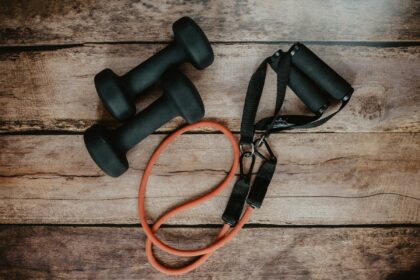
Choose loads that leave you one or two good repetitions short of your limit on most sets. If the number of sets and repetitions is new territory, our explainer on choosing sets and reps walks through the logic. Set up both stations before you start, with dumbbells, bench and band within a step of each other, so the transitions really are quick.
Managing effort, rest and recovery
Because supersets feel harder, it is tempting to treat the higher heart rate and heavier breathing as proof of a better workout. They are not. The goal is still good repetitions with a challenging weight, and the ACSM position stand found that advanced techniques such as training to failure did not consistently improve outcomes for healthy adults. Lift with control, stop each set with a little in reserve and let the clock savings come from shorter rests, not from rushing the lifts themselves.
- Rest after every pair. Sixty to 90 seconds is a reasonable starting point; take longer before repeating a pair that includes a demanding lower-body lift.
- Watch your technique on the second exercise. If form slips when you arrive at A2 or B2, lighten the load or add a short pause between the two movements.
- Leave a day between superset sessions. Given the higher internal load the review reported, an extra easy day may help you feel fresh for the next one.
- Breathe steadily. Exhale through the effort and avoid holding your breath, particularly when you are already breathing hard from the previous exercise.
When straight sets are still the better choice
Supersets are a tool, not a rule. There are times when the traditional approach serves you better, and a mixed workout, with one or two heavy lifts done as straight sets followed by superset pairs for the remaining exercises, often gives you the best of both.
- You are learning a new lift and need your full attention on technique.
- You are working with heavy loads near your limit on a squat or deadlift, where full recovery between sets helps you lift safely.
- Your gym is busy and holding two stations at once is impractical or unfair to others.
- You are returning after a layoff, illness or injury and want to rebuild tolerance first.
Because supersets keep your heart rate higher throughout the session, ask your doctor before adopting them if you have heart disease, high blood pressure that is not well controlled, diabetes, kidney disease, a recent injury or surgery, or if you are pregnant. Stop and seek care for chest pain, faintness, unusual breathlessness or a racing, irregular heartbeat.
TRY IT THIS WEEK
Convert one workout in four steps
- List the exercises in your current routine and time a normal session from start to finish.
- Keep your heaviest lower-body lift as straight sets and pair the rest, such as a press with a row or a hip hinge with a push-up.
- Use the same weights you use now and rest 60 to 90 seconds after each pair.
- Time the session again and note how you felt the next day before converting a second workout.
SOURCES AND FURTHER READING
This article is for general information and is not a substitute for personal medical advice.
Are you a fitness or wellness professional with a member journey to share?