



REST INTERVALS · STRENGTH AFTER 40
The minutes between sets can feel like dead time, so it is tempting to rush through them or lose them to your phone. Both habits can quietly cost you progress.
How long you rest between sets shapes your whole workout. Rest too little and the next set falls apart early; rest far too long and a session meant to take 40 minutes drifts past an hour. Research on rest between sets has matured over the past decade, and its message is encouraging for anyone training to stay strong: the right pause depends on your goal and the exercise, short rests still build strength, and longer rests pay off most when the weights are heavy. Here is what the studies show and how to put them to work.
Why the Pause Matters
Each hard set draws down the fast energy your muscles rely on and leaves them temporarily less able to produce force. Rest lets them recover enough to perform the next set well. The more fully you recover, the more weight or repetitions you can usually manage, and the total work you complete across sets, often called volume load, is one of the main drivers of gains in strength and muscle.
That makes rest part of the training dose, as real as the load on the bar or the number of repetitions. Our guides to choosing sets and reps and progressive overload cover the other pieces of that dose; this article fills in the gaps between them.
What the Research Says About Rest Between Sets
A 2018 systematic review in Sports Medicine by Jozo Grgic and colleagues focused on strength. It concluded that robust strength gains can be achieved even with short rests of under 60 seconds. For people new to lifting, short to moderate rests of 60 to 120 seconds appeared sufficient to maximize strength gains, while people with resistance-training experience seemed to need longer rests, beyond two minutes, to get the most from their work.
One widely cited trial shows the effect in experienced lifters. In a 2016 study in the Journal of Strength and Conditioning Research, summarized here by the Brookbush Institute, Brad Schoenfeld and colleagues had 21 resistance-trained men follow the same eight-week program while resting either one minute or three minutes between sets. The longer-rest group raised their one-repetition maximum in the back squat by about 15 percent, compared with about 8 percent for the shorter-rest group, and showed more growth in the front of the thigh. Because the participants were 18 to 35 and already trained, the result speaks most directly to seasoned lifters.
For muscle size, a 2024 Bayesian meta-analysis in Frontiers in Sports and Active Living pooled nine studies. It found a small benefit for resting longer than 60 seconds, but no appreciable difference once rest went beyond 90 seconds. Six of the nine studies involved untrained participants, so the authors could not say whether experienced lifters gain more from longer breaks.
The 2026 American College of Sports Medicine position stand, built on 137 systematic reviews covering more than 30,000 participants, puts these details in perspective. Its central message is that consistency counts more than complexity, starting with training all major muscle groups at least twice a week. As co-author Stuart Phillips put it in announcing the guidelines, “The best resistance training program is the one you’ll actually stick with.”
Matching Rest to Your Goal
Put together, the evidence supports a flexible approach rather than a single number. Use these ranges as starting points, then adjust based on how your next set goes.
| Goal or session type | Typical load | Suggested rest | Why |
|---|---|---|---|
| Heavy strength on big lifts such as squats, deadlifts and presses | Heavy, around 80 percent of your one-rep max for two or three sets | 2 to 3 minutes or more | Longer rest protects performance on heavy sets, especially for experienced lifters |
| Building muscle | Moderate, with more total sets across the week | About 1 to 2 minutes | Pooled studies show little extra benefit beyond about 90 seconds |
| Newer lifters building strength | Light to moderate | 60 to 120 seconds | Short to moderate rests appear sufficient early on |
| Power work | Moderate, 30 to 70 percent of max, lifted quickly | Long enough that every rep stays fast | Speed is the point, so fatigue defeats the purpose |
| Short circuits when time is tight | Light to moderate | 30 to 60 seconds, or alternate exercises | Short rests still build strength, though you may lift less |
Load and set guidance in the table reflects the 2026 ACSM position stand: heavier loads near 80 percent of maximum for two to three sets favor strength, roughly 10 weekly sets per muscle group favor growth, and moderate loads of 30 to 70 percent moved quickly favor power.
Getting More From a Shorter Session
If time is tight, you don’t have to choose between full rest and an efficient workout. Pairing exercises that use different muscles lets one area recover while the other works. A set of goblet squats followed by a set of rows, then back to squats, gives each movement a meaningful break without adding minutes to the clock.
- A squat or lunge paired with a row
- A push-up or overhead press paired with a hip hinge such as a Romanian deadlift
- Step-ups paired with a plank or a loaded carry
Keep your heaviest lift of the day on its own with full rest, then use pairings for the remaining exercises. Our full-body dumbbell workout for two days a week adapts well to this format.
How to Tell You Are Ready for the Next Set
A timer keeps you honest, but your body offers cues as well. Before you start the next set, check that:
- your breathing has settled enough to speak a full sentence comfortably;
- you feel able to match the quality of the last set, not just its count;
- the burning in the working muscles has faded;
- you have reset your stance, grip and brace with intention.
If your repetitions drop sharply from one set to the next, or your form starts to slip, rest longer or lighten the load. Recording rest times in your training log for a few weeks will quickly show which pauses keep you progressing.
Rest, Breathing and Safety
Generous rest is especially sensible when sets are heavy or when you are managing blood pressure. Breathe steadily through each repetition, typically exhaling as you lift, and avoid holding your breath for long stretches. Between sets, stand or walk slowly rather than dropping into a seat and springing back up, particularly if you tend to feel lightheaded.
Talk with your doctor before starting or intensifying resistance training if you have heart disease, high blood pressure that isn’t well controlled, diabetes or kidney disease, are pregnant, or are recovering from an injury or surgery. End a set immediately if you feel chest discomfort, dizziness or unusual breathlessness, and seek care if it doesn’t pass quickly.
TRY IT THIS WEEK
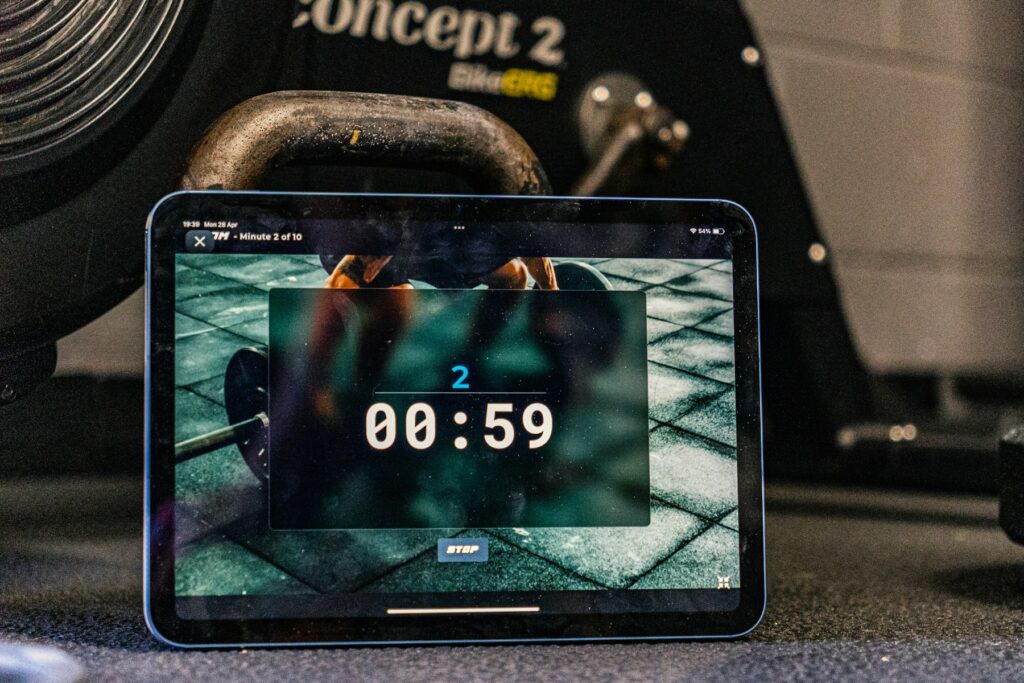
A rest-timer plan for your next session
- Pick your main lift and rest a full two to three minutes between its sets.
- For the other exercises, rest about 90 seconds, or pair two moves and alternate.
- Write down the rest you took and the reps you completed in each set.
- If reps fall by more than two from your first set to your last, add 30 seconds of rest next time.
- Review after two weeks and keep whatever kept you moving forward.
SOURCES AND FURTHER READING
This article is for general information and is not a substitute for personal medical advice.
Are you a fitness or wellness professional with a member journey to share?