DANCING · ACTIVE LIVING
If the word “workout” brings to mind treadmills and weight stacks, dancing may be the most enjoyable way to reach your activity goals without feeling as though you are training at all.
Dancing for exercise is not a lesser cousin of “real” training. Depending on the style and the tempo, it can count as moderate or vigorous aerobic activity, it challenges balance and coordination, and it asks your brain to learn and recall patterns while your body keeps moving. This guide explains how hard different styles work you, what researchers have found about dancing, heart health, falls and thinking skills, and how to fold dancing into a balanced week, whether you sign up for lessons, join a social dance night or simply turn up the music at home.
Why dancing for exercise earns a place in your week
Most adults know the federal target of at least 150 minutes of moderate-intensity aerobic activity a week, along with muscle-strengthening work on at least two days. Fewer people realize how much variety can fill those minutes. The Move Your Way guidance for older adults specifically suggests choosing activities that count as more than one type, and it names dancing, sports and tai chi as examples, because they combine aerobic effort with the kind of movement that helps keep the body strong and lowers the risk of falling.
That double duty is the real appeal. A brisk walk mainly trains your heart and legs in a straight line. A cha-cha, a line dance or a swing routine adds turns, weight shifts, quick changes of direction and moments on one foot. You get your aerobic minutes while practicing the side-to-side and rotational movements that daily life demands and that many traditional workouts leave out. And because dancing is social and set to music, it is often easier to keep doing month after month, which matters more than any single session.
How hard is dancing? Reading the intensity
The CDC’s guide to measuring intensity lists ballroom or line dancing as moderate-intensity activity and “energetic dancing” as vigorous. Its simple talk test works well on a dance floor: at a moderate effort you can talk but not sing, while at a vigorous effort you cannot say more than a few words without pausing for a breath.
Researchers also rate activities in METs, a unit that compares the energy cost of an activity with sitting quietly. The values below come from the Adult Compendium of Physical Activities, the standard reference used in exercise research. They show how much the style and pace change the workload.
| Dance style | MET value | What it feels like |
|---|---|---|
| Ballroom, slow | 3.0 | Gentle; a good place to learn footwork |
| Caribbean dance | 3.5 | Light to moderate, rhythmic |
| Contemporary dancing, general | 3.8 | Moderate, varies with the routine |
| Salsa with a partner | 4.8 | Moderate and quick-footed |
| Tap | 4.8 | Moderate, with steady leg work |
| Folk dancing, moderate | 5.0 | Moderate, often in a group |
| Ballroom, fast | 5.5 | Brisk; breathing picks up noticeably |
| Square dancing, American Western or country | 5.5 | Brisk, social, lots of turns |
| Recreational ballroom | 6.0 | Hard work over a full evening |
The practical lesson is that you control the dial. A slow foxtrot is a pleasant warm-up; a fast jive or a long square-dance set can leave you as winded as a hard bike ride. If you are new to exercise, start with the gentler styles and let the talk test, rather than the music, set your pace.
What research says about dancing and your heart
One of the larger studies on the subject followed about 48,000 adults in the United Kingdom, all 40 or older and free of heart disease at the start, for roughly 10 years. As Harvard Health Publishing summarized the findings, published in the American Journal of Preventive Medicine in 2016, moderate-intensity dancing was linked to a lower risk of dying from cardiovascular disease. The association was slightly stronger than the one seen for walking and may have been stronger in women than in men.
That is an observational result, so it cannot prove that dancing itself protected anyone; people who keep dancing for years may simply have been healthier to begin with. The researchers suggested two plausible reasons dancing could help: it often includes brief bursts of higher-intensity effort, and it brings social connection that can relieve stress. Both fit with what we know about exercise for heart health in general.
Balance, falls and a steadier step
Dancing constantly asks you to shift weight, change direction and recover your position, which is exactly the skill set that keeps you upright when a sidewalk is uneven. A 2020 systematic review and meta-analysis in JAMA Network Open pooled 29 randomized trials in healthy older adults and looked at “dance-based mind-motor activities,” a category that included ballroom, line, folk and creative dance as well as related practices such as tai chi.
Those activities were associated with a 37 percent lower risk of falling and a 31 percent lower rate of falls, along with measurable improvements in balance, mobility and lower-body strength. Most participants were older than many Stature™ readers, but the takeaway carries forward: the habits you build in your 40s and 50s are the ones you will rely on later. Our guide to fall prevention explains why it pays to start early.
A workout for your brain as well as your body
Learning a sequence of steps, remembering it under the pressure of a tempo and coordinating with a partner is demanding mental work. In a well-known study of 469 community-dwelling adults older than 75 who did not have dementia at the start, Joe Verghese and colleagues found that reading, board games, playing a musical instrument and dancing were each associated with a reduced risk of developing dementia over a median follow-up of about five years. The authors were careful to say that controlled trials were needed to show cause and effect.
A small randomized trial from the same research group then compared six months of ballroom dancing with six months of treadmill walking in 25 older adults at higher risk of dementia. According to Montefiore Einstein, both groups improved on overall tests of executive function compared with where they started, and the difference between groups was not significant, although the dancers improved more on a digit-symbol substitution test. The fair summary is that dancing appears to be at least as good for thinking skills as walking, with the added bonus of being a skill you can keep refining. For the broader picture, see our report on exercise and brain health.
Choosing a style and getting started
The best style is the one whose music makes you want to show up. Many community centers, recreation departments and dance studios offer beginner classes, and plenty of styles do not require a partner. A few practical pointers will make the first weeks smoother.
- Start with a beginner series, not a drop-in night. A four- to eight-week course teaches the basic steps in order, so you spend less time lost and more time moving.
- Pick a style that matches your current fitness. Slow ballroom, line dancing and folk dancing are gentle entry points; salsa, swing and fast ballroom ask more of your heart and calves.
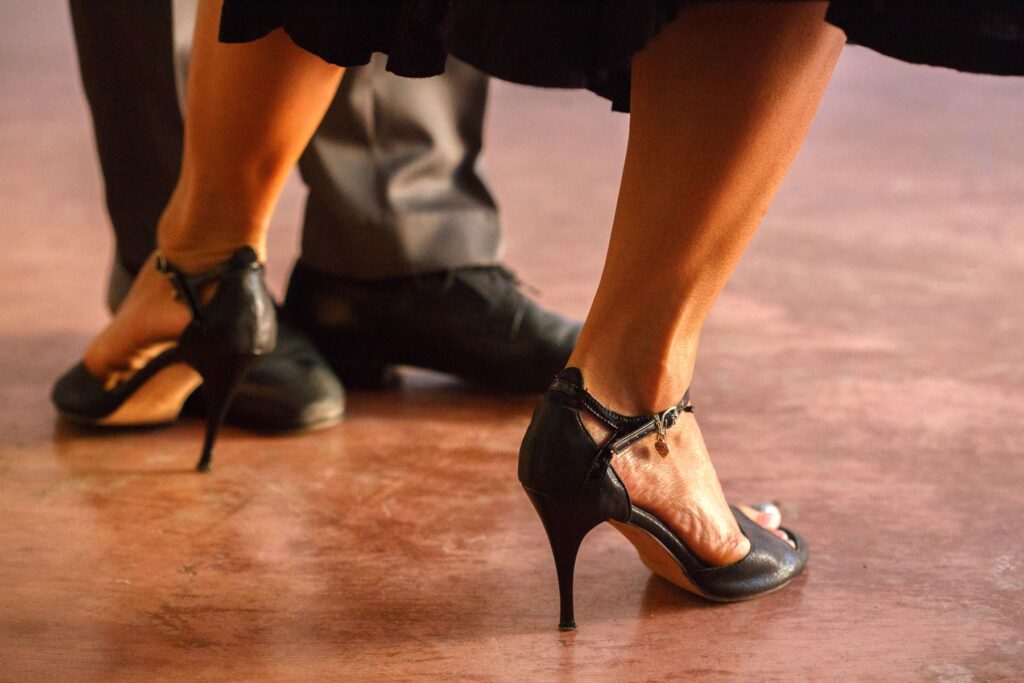
- Wear the right shoes. Smooth-soled shoes that let you pivot are kinder to knees than grippy running shoes, which can catch on a wooden floor during turns.
- Warm up before the music speeds up. March in place, roll your shoulders and practice a few slow steps for five minutes before the first full-tempo song.
- Take breaks and drink water. A social dance can run two or three hours, far longer than a typical workout, so sit out a song whenever you need one.
- Dance at home between classes. Ten minutes of practice to a favorite playlist reinforces the steps and adds easy activity minutes.
If joining a class feels intimidating, our advice on finding a group fitness class that feels like yours applies just as well to a dance studio: visit once to watch, ask about the beginner track and give it at least three sessions before deciding.
Fitting dance into a balanced weekly plan
Dancing covers a lot of ground, but it does not replace everything. Even fast styles provide limited resistance for the upper body, and most do little to load the muscles of the back and chest. Pair your dancing with two short strength sessions and you have a well-rounded week.
| Day | Activity | Approximate time |
|---|---|---|
| Monday | Full-body strength session | 30 minutes |
| Tuesday | Dance class (moderate pace) | 60 minutes |
| Wednesday | Brisk walk | 30 minutes |
| Thursday | Full-body strength session | 30 minutes |
| Friday | Practice at home to music | 15 to 20 minutes |
| Saturday | Social dance or second class | 45 to 90 minutes, with breaks |
| Sunday | Rest or an easy walk | As you like |
Count only the minutes you spend moving at a moderate effort or harder; time chatting at the table is good for your mood but adds few active minutes. If you have heart disease, diabetes, kidney disease, joint replacements, balance problems, new symptoms such as chest discomfort or dizziness, or you are pregnant or recovering from surgery or an injury, talk with your doctor before starting or stepping up a dance program, and stop and seek care if a session brings on chest pain, unusual shortness of breath or light-headedness.
YOUR FIRST MONTH ON THE DANCE FLOOR
A four-week starter checklist
- Week one: choose a style, find a beginner series nearby and book the first class.
- Week two: practice the basic step at home for ten minutes on two other days.
- Week three: use the talk test during class and note whether you stayed moderate or drifted into vigorous.
- Week four: add two short strength sessions and log your total active minutes for the week.
SOURCES AND FURTHER READING
Centers for Disease Control and Prevention · How to Measure Physical Activity Intensity
Adult Compendium of Physical Activities · Dancing
Office of Disease Prevention and Health Promotion · Move Your Way Fact Sheet for Older Adults
Harvard Health Publishing · Dance Your Way to Better Heart Health?, 2016
Verghese J, et al. · Leisure Activities and the Risk of Dementia in the Elderly
Montefiore Einstein · Social Dancing to Improve Cognition, Reduce Alzheimer’s Risk, 2023
This article is for general information and is not a substitute for personal medical advice.
Are you a fitness or wellness professional with a member journey to share?