NORDIC WALKING · ACTIVE LIVING
If walking is already your favorite exercise but you want more from the same half hour, a pair of poles may be the simplest upgrade available.
Nordic walking is brisk walking with specially designed poles that you push against with every step. It looks almost too simple to matter, yet the poles bring your arms, shoulders and back into each stride, which raises the work of a familiar walk without making it feel much harder. This guide covers where the activity came from, what the research shows, who tends to benefit, how to choose and size poles, and how to learn the technique over four relaxed weeks.
Where Nordic walking comes from
The activity began in Finland in the early 20th century as summer training for cross-country skiers, according to Harvard Health Publishing. Skiers needed a way to keep their poling muscles conditioned without snow, so they took their poles onto trails and roads. Ben Kuharik, an exercise specialist at Cleveland Clinic, describes it as essentially the same movement cross-country skiers use, minus the snow.
That heritage explains how it differs from casual walking with a stick. A hiking or trekking pole is usually planted in front of you for support, a little like a cane. A Nordic pole is angled backward and used to push, so it adds propulsion rather than simply steadiness. The difference sounds small, but it changes which muscles do the work.
Estimates of how much of the body gets involved vary. A physical therapist quoted by Harvard Health puts it at roughly 50 to 70 percent of your muscles during ordinary walking and up to 80 to 90 percent with Nordic poles. Treat those figures as illustrations, not lab measurements: the point is that your upper body starts contributing.
What research shows about Nordic walking
One of the earliest field studies, published in 2002 in Research Quarterly for Exercise and Sport, had 22 adults walk 1,600 meters around a track with and without poles. Walking with poles raised oxygen consumption, heart rate and calorie burn, yet the volunteers did not rate the effort as significantly harder. By the study’s figures, the women burned about 5.4 rather than 4.6 calories per minute and the men about 6.9 rather than 5.7, roughly 17 to 21 percent more. The participants were in their late 20s and early 30s on average, so your numbers may differ, but the pattern is what matters: more work at the same perceived effort.
Across studies, the estimated increase in calorie burn ranges widely, from 18 to 67 percent compared with regular walking, according to both Harvard Health and Cleveland Clinic. The spread reflects differences in technique, pace, terrain and how firmly people push through the poles. If you let the poles drag behind you, you will gain little. If you plant and push with intent, you will gain considerably more.
The most striking recent evidence comes from cardiac rehabilitation. In a 2022 randomized trial in the Canadian Journal of Cardiology, researchers at the University of Ottawa Heart Institute assigned 130 people with coronary artery disease to 12 weeks of supervised high-intensity interval training, moderate-to-vigorous continuous training or Nordic walking. Functional capacity improved in all three groups, but the gain was largest with Nordic walking, at 19 percent, compared with 13 percent for interval training and 12 percent for continuous training. Harvard Health’s summary adds that participants reported better quality of life and fewer symptoms of depression.
Those volunteers were supervised, so the results may not apply to everyone, but they suggest poles can make walking more effective for the heart.
Who may get the most from walking with poles
Nordic walking suits almost anyone who can walk comfortably, but a few groups tend to notice the difference quickly.
- Walkers who have stopped progressing. If your usual loop no longer feels like exercise, poles add work without forcing you to run. Our guide to walking for health explains why pace and regularity matter as well.
- People with achy hips, knees or feet. Harvard Health notes that the poles shift some force from the legs to the upper body, easing stress on the hips, knees and feet. If joint pain has been holding you back, pair this with the ideas in our piece on exercise for arthritis.
- Anyone who wants steadier footing. Two extra points of contact add stability, and Cleveland Clinic cites a cardiac rehabilitation study in which a three-week Nordic walking program improved coordination. Harvard Health adds that poles encourage longer steps, which can help counter a shuffling gait.
- People who want upper-body work on the move. Cleveland Clinic lists the lats and traps of the back, the chest, the shoulders, the triceps and the forearms among the muscles involved.
- Walkers short on time. By some estimates cited by Cleveland Clinic, you can cover ground up to 25 percent faster with poles than without them.
There are sensible exceptions. Kuharik advises against Nordic walking while you recover from an upper-body injury, because pushing through the poles loads the wrists, elbows and shoulders. Harvard Health recommends checking with your doctor first if you are new to the activity, have serious health issues, or have recently recovered from an injury or surgery. If you live with heart disease, ask your care team how hard to work; our guide to exercise for heart health covers the broader picture.
How to choose and size Nordic walking poles
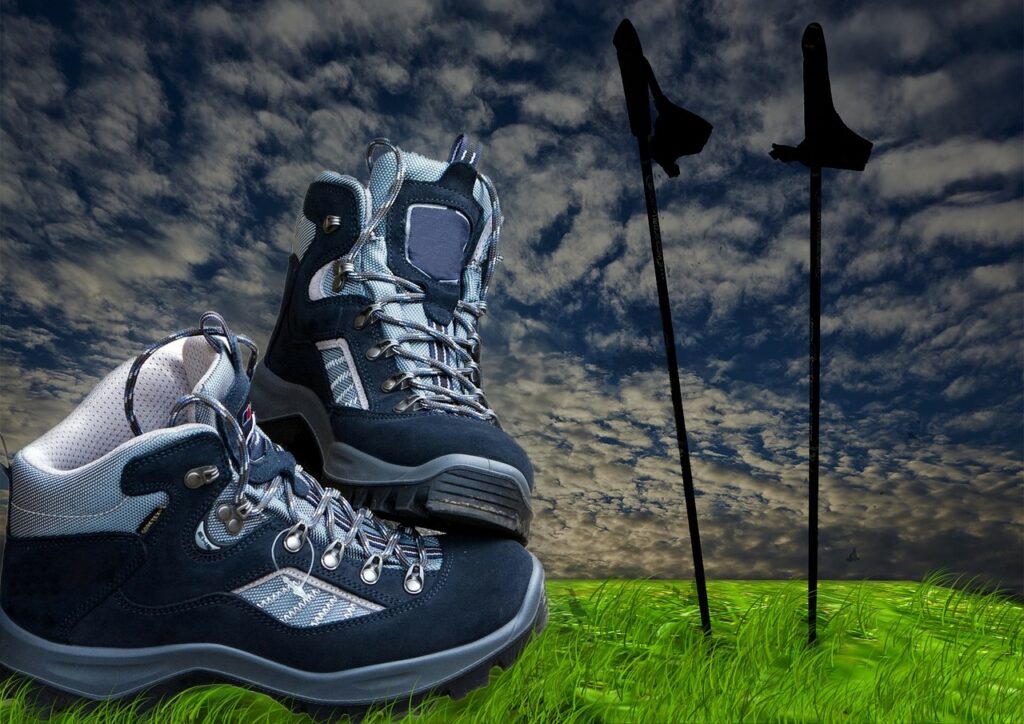
Nordic poles differ from trekking poles in one important way: the strap. Each Nordic pole has a glove-like strap that lets you push through your palm rather than squeezing with your fingers, Harvard Health explains. That design is what allows you to relax your hand on the backswing while the pole stays attached to you.
- Strap: look for a glove-style or half-glove strap that fits snugly around your hand.
- Material: poles come in lightweight aluminum or carbon; both work well for most walkers.
- Tips: pointed tips grip trails and dirt, while blunt rubber tips suit sidewalks and paved paths. Some poles let you swap one for the other.
- Length: choose an adjustable pole. Harvard Health’s rule of thumb is that the length is right when your palm rests on top of the grip with your elbow bent to about 90 degrees.
- Price: Cleveland Clinic notes that adjustable poles start around $20, with higher-end models costing about $100.
- Shoes: supportive walking shoes matter as much as they do for any walking program.
Nordic walking technique, step by step
Cleveland Clinic points to a 10-step method developed by the International Nordic Walking Federation and built on natural walking mechanics. You do not need to memorize all ten steps to start. These cues cover the essentials.
- Walk normally for a minute with the poles trailing behind you, so your arms find their natural swing.
- Let your arms and legs alternate as they do in ordinary walking: right arm forward with the left foot, left arm forward with the right foot.
- Keep the poles angled backward at your sides. Avoid reaching them out in front of you like a hiking stick.
- Plant each tip beside your body, about midway between your feet, then press down and back to drive yourself forward.
- Keep a light grip. The strap holds the pole, so your hand can loosen as your arm passes behind your hip.
- Lengthen your stride slightly and roll through each foot from heel to toe.
- Stand tall, with your chin up, shoulders back and chest open.
Once that pattern feels natural, Harvard Health describes a second option. Single poling, the everyday pattern, plants one pole per stride. Double poling plants both poles together in front of you and lets you pull yourself forward over three steps before repeating, a useful change of pace on a gentle rise. The most common early mistakes are poles set too long, a white-knuckle grip and short, choppy steps, so check those first if the movement feels awkward.
A four-week plan for starting Nordic walking
Harvard Health suggests beginning on level surfaces such as sidewalks or paths before moving to trails with varied surfaces and hills. If you normally walk for 20 to 30 minutes, use the poles for only about a quarter of that time at first, then increase as the rhythm improves. The goal is two or three Nordic walking sessions a week lasting 30 minutes to an hour or longer.
| Week | Sessions | Time with poles | Focus |
|---|---|---|---|
| 1 | 2 to 3 | About a quarter of a 20- to 30-minute walk | Opposite arm and leg, poles trailing behind |
| 2 | 3 | About half of the walk | Planting beside the body and pushing back |
| 3 | 3 | Most of a 30-minute walk | Longer stride, relaxed grip, gentle hills |
| 4 | 3 | 30 to 45 minutes, poles throughout | Varied surfaces and short, brisker stretches |
Three 45-minute pole walks add up to 135 minutes a week, close to the floor of the 150 to 300 minutes of moderate aerobic activity recommended for adults by the Physical Activity Guidelines for Americans. Add a couple of shorter everyday walks and two strength sessions, and you have a well-rounded week. Expect your shoulders and upper back to feel the work for the first few outings; mild muscle fatigue is normal, but sharp pain in a joint is a signal to stop and get it checked.
BEFORE YOUR FIRST POLE WALK
A five-minute pole check
- Set the length so your elbow bends to about 90 degrees with your palm on the grip.
- Adjust the straps until you can open your hand without the pole slipping away.
- Fit rubber tips for pavement or pointed tips for dirt paths.
- Choose a flat, familiar route that takes 20 to 30 minutes.
- Use the poles for the first quarter of the walk, then let them trail.
- If you have a heart condition, a recent injury or surgery, or a sore wrist, elbow or shoulder, talk with your doctor or physical therapist first.
SOURCES AND FURTHER READING
Harvard Health Publishing · Take a Nordic Walk
This article is for general information and is not a substitute for personal medical advice.
Are you a fitness or wellness professional with a member journey to share?