DUMBBELL TRAINING · STRENGTH AFTER 40
You own a pair of dumbbells, or you are thinking about buying some, and you want one plan that covers the whole body without living at the gym.
A full-body dumbbell workout done twice a week can do exactly that. Dumbbells are compact, affordable and versatile enough to train your legs, hips, back, chest, shoulders, arms and core. Below you will find seven foundational moves, a two-day plan, guidance on choosing the right weights, and a simple way to keep progressing for months without overcomplicating things.
Why a Full-Body Dumbbell Workout Covers the Basics
The Centers for Disease Control and Prevention (CDC) recommends muscle-strengthening activity on at least two days a week that works all major muscle groups: legs, hips, back, abdomen, chest, shoulders and arms. A full-body session trains all of them at once, so two sessions meet the guideline without separate leg days and arm days.
The evidence also supports simple equipment. In March 2026 the American College of Sports Medicine (ACSM) published its first new resistance training position stand since 2009, built on 137 systematic reviews involving more than 30,000 participants. Its public summary says elastic bands, bodyweight exercises and home-based training are effective options, and that choosing machines or free weights did not consistently change results. If you are weighing the two, our comparison of free weights vs. machines goes deeper. Its most encouraging line is also its simplest: the biggest jump in results happens when you go from no resistance training to any.
Dumbbells add a few practical advantages. Each arm and leg works independently, which can reveal and gradually even out side-to-side differences. Your wrists and shoulders can follow their natural path rather than a fixed bar, and a few pairs take up less floor space than a single weight bench.
Choosing Your Weights
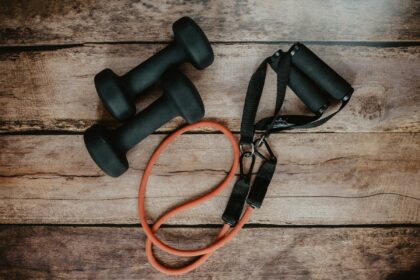
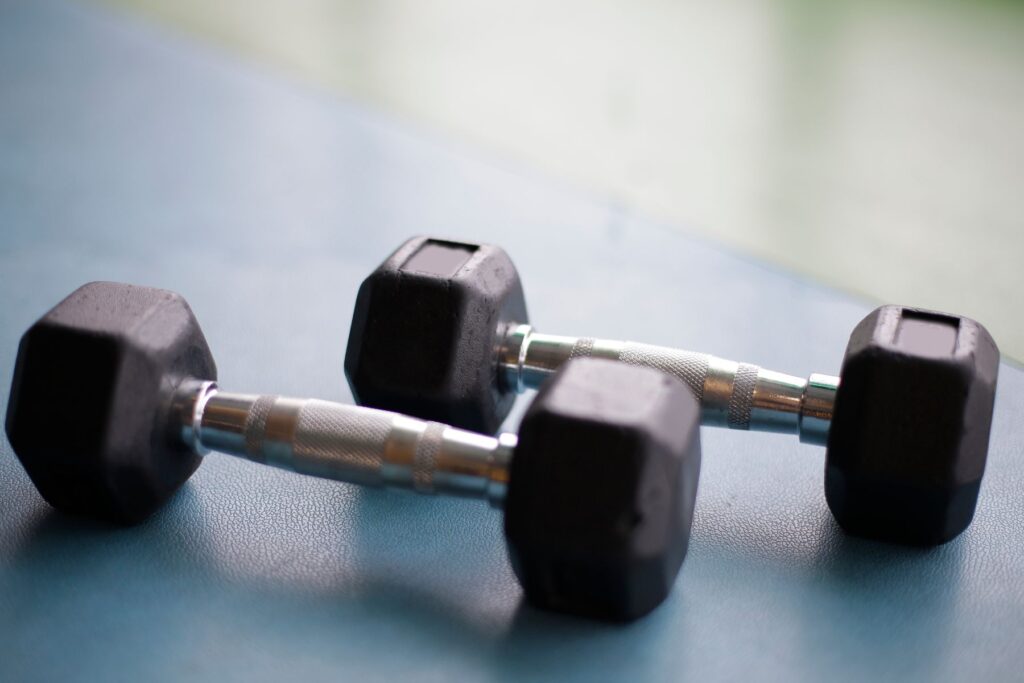
Most people need more than one pair. Your legs and hips can handle far more load than your shoulders, so a light, a medium and a heavier pair, or one adjustable set, lets you match the weight to the movement.
Mayo Clinic suggests starting with a weight you can lift comfortably 12 to 15 times and increasing gradually, and only when your technique holds. For building strength over time, the ACSM recommends working toward heavier loads, around 80% of the most you could lift once, for two to three sets per exercise. You do not need to test your one-time maximum to use this advice. In everyday terms, a heavier load is one that makes the last few repetitions of a set hard while your form stays clean, and you reach it over weeks, not days.
Training to complete muscle failure is not required. The ACSM found that going to failure did not consistently change results for the average healthy adult, so ending each set with a little left in reserve is a sensible default, especially when you lift at home without a spotter.
The Seven Moves
Learn each movement with a light weight first. Move slowly and under control, and breathe out as you lift and in as you lower, as Mayo Clinic advises. Never hold your breath through a repetition.
- Goblet squat. Hold one dumbbell vertically against your chest, feet about shoulder-width apart, and sit your hips down and back between your heels before standing tall. Our step-by-step guide to the goblet squat covers depth and foot position.
- Romanian deadlift. Hold a dumbbell in each hand in front of your thighs. With soft knees, push your hips back and slide the weights down your legs until you feel a stretch in your hamstrings, then drive your hips forward to stand. If the movement is new, learn the hip hinge first.
- One-arm row. Place one hand and the same-side knee on a bench or sturdy chair, keep your back flat, and pull the dumbbell toward your hip, leading with your elbow. Lower it with control.
- Floor or bench press. Lie on the floor or a bench holding a dumbbell in each hand above your chest. Lower them with your elbows angled slightly in toward your body rather than flared straight out, then press back up. The floor version limits the range and is often kinder to the shoulders.
- Split squat. Stand in a long stride with a dumbbell in each hand. Lower your back knee toward the floor, then press through your front foot to rise. Hold a chair or wall with one hand for balance until you feel steady.
- Overhead press. Sit or stand tall with the dumbbells at shoulder height and press them overhead without arching your lower back. If reaching overhead is uncomfortable, use a lighter weight and a slight forward angle, or leave it out until your shoulders move more freely.
- Farmer’s carry. Pick up a heavier dumbbell in each hand, stand tall, and walk with short, steady steps. It trains grip, posture and the deep trunk muscles that keep your spine stable while you move.
Your Two-Day Plan
Split the seven moves across two days, with each session training the whole body. Leave at least one day between sessions, since Mayo Clinic advises against exercising the same muscles two days in a row. Warm up first with 5 to 10 minutes of brisk walking or other light aerobic activity, then do one easy practice set of your first exercise.
| Day | Exercise | Sets and reps for the first weeks |
|---|---|---|
| Day A | Goblet squat | 2 to 3 sets of 12 to 15 |
| Day A | One-arm row | 2 to 3 sets of 12 to 15 per side |
| Day A | Floor or bench press | 2 to 3 sets of 12 to 15 |
| Day A | Farmer’s carry | 2 to 3 walks, stopping before posture fades |
| Day B | Romanian deadlift | 2 to 3 sets of 12 to 15 |
| Day B | Split squat | 2 to 3 sets of 12 to 15 per leg |
| Day B | Overhead press | 2 to 3 sets of 12 to 15 |
| Day B | One-arm row | 2 to 3 sets of 12 to 15 per side |
If you are brand new to lifting, start with a single set of each exercise. Mayo Clinic notes that for most people, completing one set to the point of fatigue is usually enough, and extra sets add time and raise the risk of overload. Add a second and then a third set over the following weeks as the work starts to feel familiar. Rest long enough between sets that your next set starts with the same smooth, controlled repetitions as the first.
How to Progress Without Overreaching
Progress comes from asking your muscles to do a little more over time. Once you can complete all your sets with clean form and the final repetitions feel manageable, add a small amount of weight, an extra repetition or an extra set. Change one thing at a time so you can tell what is working. Our guide to progressive overload explains each option in more detail.
Keep the long view. The ACSM found that complex periodization schemes did not consistently change results for the average healthy adult. Stuart Phillips, quoted in McMaster University’s announcement of the new guidance, put it plainly: “Rigid rules and prescriptive ideal programs are no longer supported by evidence.” Consistency week after week matters far more than a perfect plan.
If building muscle size is a goal, the ACSM suggests working toward roughly 10 sets per muscle group each week. Two full-body sessions get you partway there, and you can add a third session or a few extra sets once recovery feels comfortable and your joints are happy.
Safety and Form Checkpoints
- Warm up for 5 to 10 minutes before you lift.
- Choose a weight that lets you control both the lifting and lowering phases without swinging or rushing.
- If an exercise causes pain, stop. Mayo Clinic suggests trying it again in a few days or with less weight.
- Clear the floor around you and set dumbbells down gently rather than dropping them.
- If you are new to lifting, a session or two with a physical therapist, athletic trainer or qualified coach can help you learn the moves.
Talk with your doctor before starting or intensifying strength training if you have heart disease, high blood pressure that is not well controlled, diabetes, kidney disease, osteoporosis, a recent injury or surgery, or new symptoms such as chest pain or dizziness, or if you are pregnant. Most people can lift safely with the right adjustments, and your care team can help you find them.
YOUR FIRST SESSION CHECKLIST
Before you pick up the dumbbells
- Gather a light, a medium and a heavier pair, or set up an adjustable set.
- Pick two fixed training days with at least one rest day between them.
- Practice each move slowly with a light weight before adding sets.
- Write down the weight, sets and reps for every exercise, every session.
- Mark your calendar two weeks from today to make your first small increase.
This article is for general information and is not a substitute for personal medical advice.
Are you a fitness or wellness professional with a member journey to share?