




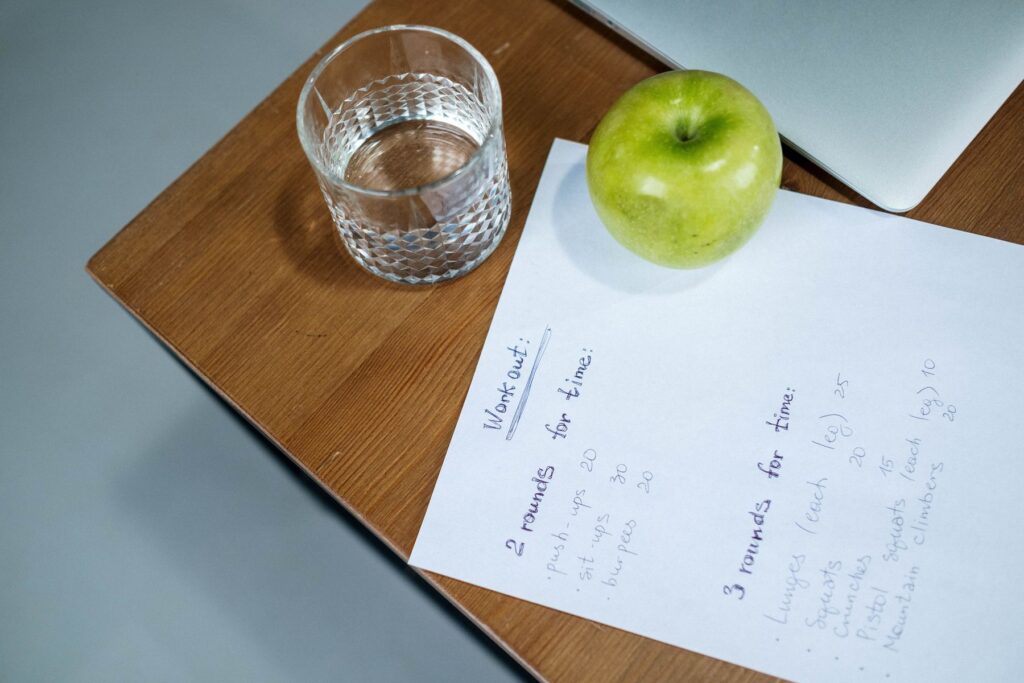
TRAINING LOG · MEMBER JOURNEYS
You have been training for a few months, and you are fairly sure you are stronger. But was that dumbbell 20 pounds or 25 last time, and did your knee complain after squats or after the long walk?
A workout log answers those questions in seconds. It is the least glamorous tool in fitness and one of the most useful, because it turns a string of separate sessions into a record you can learn from. This guide explains what the research says about tracking, what is worth writing down, how to choose between paper and an app, and how a short weekly review turns your notes into better decisions. It is written for the stage of your journey when the novelty has worn off and steady progress matters more than motivation.
What a log does that memory cannot
Memory is a generous editor. It tends to round up the good sessions, forget the skipped ones and blur the details that matter most for planning, such as the exact weight, the number of repetitions and how hard the last set felt. Without those details, every workout becomes a guess, and guesses drift toward whatever feels comfortable.
A written record removes the guesswork. When you know you did three sets of eight with a given weight last Tuesday, you can decide with confidence whether to add a repetition, add a little load or hold steady. That is the heart of progressive overload, and it is much easier to apply when the numbers are in front of you. A log also shows patterns that are invisible day to day, like the way your energy dips after short nights or a nagging ache that only appears after a particular exercise.
There is a quieter benefit, too. Looking back over weeks of entries is tangible proof that you have shown up, and that evidence tends to carry you through the flat stretches when progress is hard to feel.
What the research says about keeping a workout log
Self-monitoring is one of the best-studied tools in behavior change. A meta-analysis led by Benjamin Harkin and published in Psychological Bulletin pooled 138 studies with 19,951 participants, mostly on personal health goals. As the American Psychological Association summarized, prompting people to monitor their progress made them more likely to reach their goals, more frequent monitoring was linked to greater success, and the effect was larger when progress was physically recorded or reported publicly.
The same analysis found an interesting nuance: monitoring a behavior mainly changed the behavior, while monitoring an outcome mainly changed the outcome. For training, that suggests logging both what you do, such as sessions, sets and minutes, and a few results you care about, such as the weight you can lift or how long a walk takes.
Tracking seems to work best when it is paired with a goal. A 2009 meta-regression in Health Psychology of 122 evaluations of healthy eating and physical activity programs found that interventions combining self-monitoring with at least one other self-regulation technique drawn from control theory were more effective than others. Pedometer research points the same way. In a 2007 JAMA review of 26 studies summarized by American Family Physician, pedometer users in randomized trials took about 2,004 more steps a day than controls, and having a step goal was a key factor in that increase.
What to write down
The best log is detailed enough to guide your next session and short enough that you will keep it. For most people, that means a handful of fields per exercise plus a line or two about the day. You can always add more later.
| Field | Example | Why it helps |
|---|---|---|
| Date and session type | Tue · Strength A | Shows consistency and spacing between sessions |
| Exercise | Goblet squat | Keeps the same movement comparable over time |
| Load, sets and reps | 25 lb · 3 × 8 | The core numbers for planning progression |
| Effort | “2 reps left in the tank” | Tells you whether the weight is still challenging |
| Cardio details | 30 min walk · 1.8 miles | Tracks weekly minutes and pace changes |
| Notes | Slept 6 hours; left knee fine | Reveals patterns in energy, aches and recovery |
The effort column is worth a moment of explanation. Rather than chasing exhaustion, many coaches ask how many more good repetitions you could have done at the end of a set. Writing “1 left” or “3 left” gives you a simple, honest gauge of difficulty, and it fits with the 2026 American College of Sports Medicine resistance training position stand, which reports that training to fatigue or failure did not consistently change outcomes for the average healthy adult.
Paper, app or spreadsheet?
There is no wrong format, only the one you will actually open. Each has trade-offs worth weighing before you commit.
- A paper notebook is cheap, fast and free of distractions. It lives in your gym bag, never needs charging and makes flipping back a few weeks easy. Its weakness is that totals and trends take a little arithmetic.
- A training app remembers your last numbers, builds charts and often suggests the next load. The risk is spending more time tapping than training, so look for one that lets you log a set in a few seconds.
- A spreadsheet suits people who like to see weekly totals, such as minutes of cardio or sets per muscle group, at a glance. Many people jot notes on paper during the session and transfer them weekly.
- A wearable or phone can capture steps, heart rate and walking distance automatically. It is a useful supplement, but it rarely records lifting details well, so pair it with one of the options above.
Whatever you choose, keep the layout identical from session to session. Consistency is what makes comparison possible.
The weekly review: turning notes into decisions
A log you never read is just a diary. Set aside ten minutes at the end of each week, perhaps on Sunday evening, to look over your entries and decide what changes. The questions below cover most of what matters.
- Did I do what I planned? Count sessions and total cardio minutes against your target, such as 150 minutes of moderate activity and two strength days.
- Where did I have reps to spare? If you finished every set of an exercise with two or more repetitions left, nudge the load or reps up next week.
- What stalled? If a lift has not moved in three or four weeks, look at sleep, stress and session spacing before changing the program. Our guide to breaking through a fitness plateau covers the usual causes.
- What did my body say? Scan the notes column for recurring aches or low-energy days and adjust volume, exercise choice or timing.
- What is the one change for next week? Pick a single adjustment. Small, deliberate changes are easier to evaluate than several at once.
Every month or so, zoom out. Compare a recent week with one from four or eight weeks ago and note the differences in load, minutes or how a familiar walk felt. Those comparisons are often the most motivating thing a log can show you, and they make it easier to set the next goal. If goal setting itself feels shaky, Stature™’s guide to fitness goals you’ll keep pairs well with this habit.
Common logging mistakes, and easy fixes
- Logging everything. Twenty fields per exercise is a recipe for quitting. Start with load, sets, reps and one effort note.
- Waiting until later. Details fade within hours. Jot numbers between sets or immediately after the session.
- Only recording good days. Short or skipped sessions belong in the log, too. They explain stalls and reveal scheduling problems.
- Changing exercise names. Call a movement the same thing every time so you can compare like with like.
- Treating the log as a scorecard. Numbers will rise and dip with sleep, stress and travel. The trend over months is what counts.
If you have a health condition that affects exercise, such as heart disease, diabetes or kidney disease, or you are returning after an injury or surgery, your log can be a valuable thing to bring to appointments. Notes on what you did and how you felt give your doctor or physical therapist far more to work with than memory alone. Check with them before stepping up the intensity of your training.
START YOUR LOG TODAY
A one-page template you can copy
At the top of a page, write the date, session type, hours slept and a 1 to 5 energy rating. Below that, give each exercise one line: name, load, sets × reps and reps left on the final set. For cardio, record minutes, distance or route, and whether you could talk comfortably. Finish with one sentence on anything that felt off or especially good.
Then put a recurring ten-minute review on your calendar for the end of each week, and decide on one change before you close the notebook.
SOURCES AND FURTHER READING
This article is for general information and is not a substitute for personal medical advice.
Are you a fitness or wellness professional with a member journey to share?