



GRIP STRENGTH · STRENGTH AFTER 40
A jar lid that will not budge, grocery bags that bite into your fingers, a dumbbell that slips before your legs are tired. Your hands are often where lost strength shows up first, and they are easy to train.
Grip strength is the force your hand and forearm can produce when you squeeze or hold something. Researchers measure it with a handheld device called a dynamometer, and it has become one of the most studied markers of overall strength and health. This guide explains what the studies show, why your grip matters in daily life and in the gym, and how to build grip strength with six exercises and a simple routine you can add to your existing workouts twice a week.
What grip strength tells researchers
The Prospective Urban Rural Epidemiology study, known as PURE, analyzed 139,691 adults in 17 countries, recruited from households with at least one member aged 35 to 70. Over a median of four years, the findings published in The Lancet linked every 5-kilogram drop in grip strength (about 11 pounds) with a 16 percent higher risk of death from any cause and a 17 percent higher risk of cardiovascular death. Grip was a stronger predictor of those outcomes than systolic blood pressure.
A second large analysis, published in The BMJ in 2018, followed 502,293 UK Biobank participants aged 40 to 69 for an average of about seven years. Each 5-kilogram lower grip was associated with a 20 percent higher risk of death from any cause in women and 16 percent in men. The authors noted that several associations were stronger in the younger age group, which makes grip a relevant marker in your 40s and 50s, not only later.
An important caution: these are observational studies. Grip strength appears to act as a window onto your overall muscular fitness and health rather than a cause in itself. Squeezing a hand gripper is unlikely to change your risk on its own. The goal is to build a strong body in which a strong grip is one visible sign.
Why your grip matters in daily life and in the gym
A Cleveland Clinic geriatric medicine specialist, Ardeshir Hashmi, MD, told the clinic’s health site that grip strength naturally begins to decline around age 50, and maybe even earlier. That decline shows up in practical ways: carrying luggage up stairs, opening packaging, holding a railing firmly on an icy step or keeping a firm hold on a pet’s leash.
In the gym, grip is often the weak link. If your hands give out during rows, deadlifts or carries, your back and legs never get the full training effect. Strengthening your grip lets the bigger muscles do their work, which supports the gradual progress described in our guide to progressive overload.
The three kinds of grip you can train
Coaches usually divide grip into three qualities. Training all three gives you the most useful, well-rounded hands.
- Crush grip: closing your hand around something, like a handshake or squeezing a ball.
- Support grip: holding on for time, like carrying heavy bags or hanging from a bar.
- Pinch grip: holding something between your fingers and thumb, like lifting a flat box by its edge.
Your wrists and the muscles that open your hand matter too. Balanced forearms tend to feel better over time than forearms trained only in one direction.
Six grip strength exercises that work
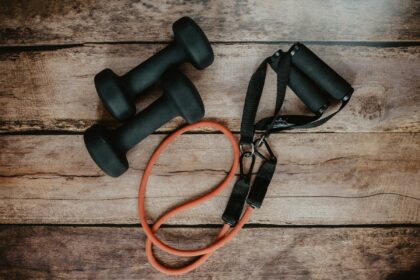
- Farmer’s carry (support). Hold a heavy dumbbell or kettlebell in each hand, stand tall with shoulders down, and walk with short, steady steps. Stop before your grip opens or your posture slumps. Grocery bags or water jugs work at home.
- Dead hang (support). Hang from a pull-up bar with straight arms and shoulders gently engaged. If a full hang is too much, keep your feet on a box or the floor and let your hands carry part of your weight.
- Plate pinch (pinch). Pinch two smooth weight plates together, smooth sides out, and hold them at your side. Start light; this one is harder than it looks.
- Towel row or hold (crush and support). Drape a towel over a cable handle or a kettlebell and grip both ends to row or hold. The thicker handle makes your fingers work harder.
- Wrist curls and reverse wrist curls (wrists and forearms). Rest your forearm on your thigh or a bench and curl a light dumbbell up with palm facing up, then repeat with palm facing down.
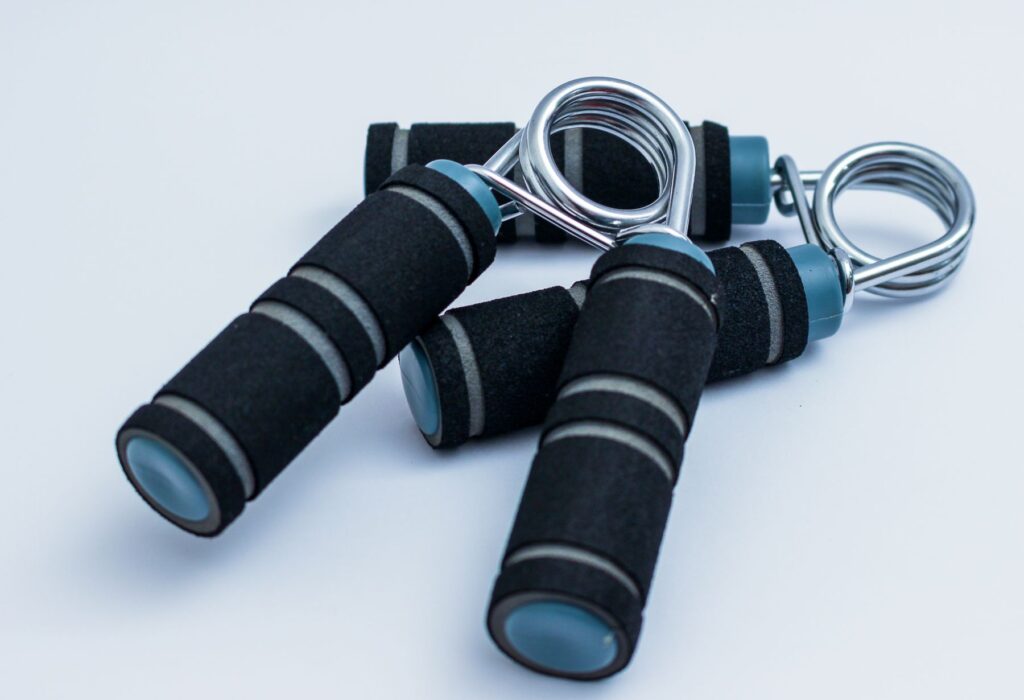
- Ball squeezes plus finger extensions (crush and balance). Squeeze a ball firmly, then open your hand against a rubber band looped around your fingers. Cleveland Clinic suggests a hollow squash ball or racquetball; a tennis ball is too big, and very soft balls give too little resistance.
A twice-weekly grip routine
The American College of Sports Medicine’s 2026 resistance training position stand advises training all major muscle groups at least twice a week and notes that training to failure did not consistently change outcomes for the average healthy adult. Apply the same thinking to your hands: finish each set with a little left in reserve. Add three or four of these exercises to the end of two existing strength sessions, rotating them each week.
| Exercise | Sets | Work per set | Rest |
|---|---|---|---|
| Farmer’s carry | 3 | 30–40 steps | 60–90 sec |
| Dead hang, full or feet-assisted | 3 | 10–30 sec | 60 sec |
| Plate pinch | 2–3 | 15–20 sec per hand | 60 sec |
| Towel row | 2–3 | 8–10 reps | 60–90 sec |
| Wrist curl and reverse wrist curl | 2 each | 12–15 reps | 45 sec |
| Ball squeeze and band extension | 2 each | 10–15 reps per hand | 30 sec |
Progress slowly. When you can complete the top of a range with good form for two sessions in a row, add a few steps, a few seconds or a small amount of weight. Grip also benefits from heavier full-body lifts such as rows and deadlifts, which the ACSM statement favors for strength: heavier loads of about 80 percent of your one-repetition maximum for 2 to 3 sets. If you are newer to lifting, our guide for first-time lifters covers the basics.
Protecting your hands, wrists and elbows
The small tendons of the hand and forearm adapt more slowly than muscle, so restraint pays off. Cleveland Clinic advises starting with low resistance on grip tools and increasing it gradually. Expect forearm fatigue during a set, but treat sharp pain, tingling, numbness or pain at the elbow that lingers the next day as signals to back off.
- Keep grip work to two or three sessions a week, with a day between them.
- Warm up with gentle fist clenches, finger spreads and wrist circles.
- Use chalk or a dry towel for carries and hangs, so you train your grip rather than fight sweaty hands.
- If you have hand arthritis, carpal tunnel symptoms or a past wrist injury, ask your doctor, a physical therapist or a hand therapist which exercises suit you.
Strong hands also support faster, more explosive movements; if that interests you, see why power training belongs in your strength routine. And because muscle needs raw material, make sure your meals include enough protein, as covered in our protein guide.
TRY IT THIS WEEK
Your grip baseline in three simple checks
- Hang time: how many seconds you can hang, full or feet-assisted, with good shoulder position.
- Carry distance: how many steps you can walk with a pair of dumbbells you can lift comfortably before your grip opens.
- Daily-life check: one task that feels hard for your hands today, such as a stubborn jar or a heavy suitcase.
- Write the numbers down, train twice a week for six weeks with the same weights, and test again.
SOURCES AND FURTHER READING
Cleveland Clinic · Grip strength and what it says about your health
This article is for general information and is not a substitute for personal medical advice.
Are you a fitness or wellness professional with a member journey to share?