


LIFTING TECHNIQUE · STRENGTH
You have learned the moves, chosen your weights and started counting reps, yet the hardest part of a set often comes with a quiet habit: holding your breath. A few small changes to how you breathe can make every rep steadier and easier on your blood pressure.
Breathing during strength training rarely gets much attention, partly because it feels automatic. But under load, many people clamp down without noticing, especially on the final reps of a set. This article explains why that matters, what happens inside your body when you hold your breath, the simple pattern most experts recommend, how bracing fits in for heavier lifts and who should be especially careful. It finishes with a few drills to make good breathing second nature.
Why Breathing During Strength Training Matters
The American Heart Association puts it plainly: holding your breath can raise blood pressure and cause muscle cramping. Its advice is to breathe regularly throughout your warm-up, your exercise routine and your cool-down, and it adds that regular, deep breathing can also help you relax.
Mayo Clinic’s guide to weight training technique makes the same point from a coaching angle. Rather than holding your breath, it says, breathe out as you lift the weight and breathe in as you lower it. That one cue does a lot of work. It keeps oxygen flowing, it gives each rep a rhythm, and it acts as a built-in check on whether the weight you have chosen is manageable.
For readers in midlife and beyond, the stakes are a little higher. Blood pressure tends to be a bigger consideration than it was at 25, and many people are training with eye, heart or metabolic conditions in the background. Good breathing habits cost nothing and fit every program.
What Happens When You Hold Your Breath
Straining against a closed airway has a name: the Valsalva maneuver. Cleveland Clinic describes it as pushing air out with your nose and mouth closed, the same effort you might make when straining on the toilet. Doctors sometimes use it deliberately to slow certain fast heart rhythms.
The maneuver sets off a sequence of rapid changes. While you strain, blood pressure rises briefly. Then, because less blood returns to the heart, blood pressure and the heart’s output fall and heart rate climbs. When you release the strain, blood pressure dips again, then rebounds above its starting level before settling back to normal.
Most people can do this safely, Cleveland Clinic notes, but possible complications include chest pain, fainting, abnormal heart rhythms and stroke. It also advises people with retinopathy or an intraocular lens implant, such as after cataract surgery, to avoid the maneuver because it raises pressure inside the eyes, and it urges caution for people with heart valve disease, coronary artery disease or congenital heart disease.
The Basic Pattern: Exhale on the Effort
For most strength exercises, the effort phase is the part where you move against resistance, usually pushing, pulling or standing up. Breathe out through that phase and breathe in during the easier return. The table below translates the cue into common moves.
| Exercise | Breathe out while you | Breathe in while you |
|---|---|---|
| Squat or goblet squat | Stand up from the bottom | Lower into the squat |
| Push-up or chest press | Push away from the floor or bench | Lower back down |
| Row | Pull the weight toward you | Let the weight return |
| Overhead press | Press the weight up | Bring it back to your shoulders |
| Hip hinge or deadlift | Drive your hips forward to stand tall | Hinge back and lower the weight |
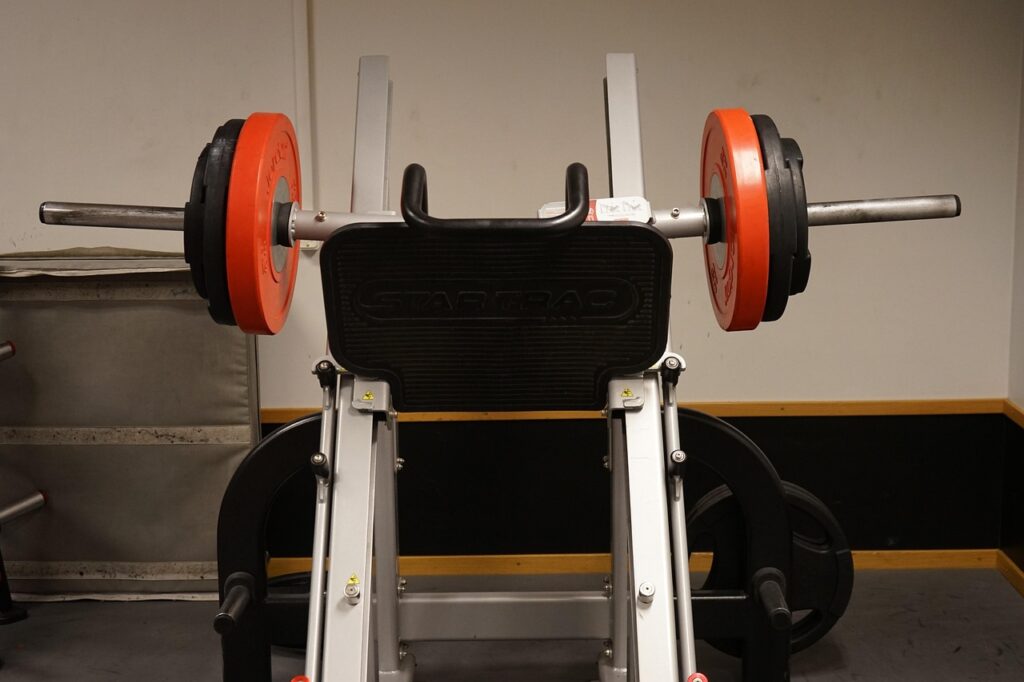
| Leg press | Push the platform away | Let the platform come back |
| Plank or other holds | Breathe slowly and steadily throughout | Keep the breath moving the whole time |
If you cannot keep breathing through a set, the load is probably too heavy for now. Mayo suggests starting with a weight you can lift comfortably 12 to 15 times, and our guide to choosing sets and reps explains how to progress from there without straining.
Bracing, Pressure and Heavier Lifts
Breathing and bracing are not opposites. A light brace, tightening the muscles around your midsection as if preparing for a gentle poke in the stomach, helps keep your spine steady while you continue to breathe. Our guide to the hip hinge shows how that steady trunk protects your back during deadlift-style moves.
Heavier lifting changes the picture. A 2019 systematic review in Biology of Sport by Blazek and colleagues gathered 16 studies measuring the pressure inside the abdomen and chest when lifters used the Valsalva maneuver during high-intensity resistance exercise. Squats produced the highest abdominal pressure, above 200 mmHg, followed by the deadlift, a row variation and the leg press. The bench press produced the lowest. Pressure in the chest was highest during the leg press, deadlift and box lift.
Based on those findings, the authors suggested the bench press and row for beginners and people with high blood pressure, and they wrote that untrained individuals should not use heavy squats, deadlifts, box lifts or cleans until they have adapted to lifting high loads. For most people training for health, strength and independence, there is little reason to chase loads so heavy that they force a breath hold. Moderate weights lifted with good breathing build plenty of strength.
Who Should Be Extra Careful
Breath-holding under load deserves particular caution if any of the following apply to you. Talk with your doctor about how to adapt your training before you start or progress.
- High blood pressure, or blood pressure that is not yet well controlled
- Heart disease, including coronary artery disease, heart valve disease or a congenital heart condition
- Retinopathy, a recent eye procedure or an intraocular lens implant
- Diabetes, kidney disease, pregnancy, a recent injury or surgery, or any new symptoms
The American Heart Association encourages people with high blood pressure to combine aerobic activity with resistance training, so a diagnosis is not a reason to avoid lifting. It is a reason to keep breathing, choose moderate loads and check with your health care team first. Our article on the best exercise to lower blood pressure covers the options in more detail. Stop and seek care if you feel dizzy, develop chest pain or notice changes in your vision during exercise.
Drills to Make Good Breathing Automatic
Like any skill, breathing well under load improves with deliberate practice. Try these at the start of your next few workouts, using light weights or none at all.
- The talk-through squat. Do 10 bodyweight squats and say “up” out loud each time you stand. Speaking forces an exhale on the effort.
- The slow-tempo set. Choose a light dumbbell and take about two seconds to lift and three to lower, breathing out and in on each phase. Mayo recommends moving the weight in a controlled way, without hurrying.
- The plank breath count. Hold a plank or a modified plank on your knees and count five slow breaths before resting. If you cannot breathe, shorten the hold.
- The reset between sets. Take three or four slow breaths before each new set to settle your heart rate and refocus.
Those pauses between sets matter more than they seem. Our guide to resting between sets explains how long to wait so each set starts with steady breathing rather than a gasp.
BREATHING CUE CARD
Four cues to take to your next workout
- Breathe out on the effort, breathe in on the return.
- Brace lightly around your middle, but keep air moving.
- If you have to hold your breath to finish a rep, lighten the load.
- Stop if you feel dizzy, lightheaded or unwell, and tell your doctor.
This article is for general information and is not a substitute for personal medical advice.
Are you a fitness or wellness professional with a member journey to share?