




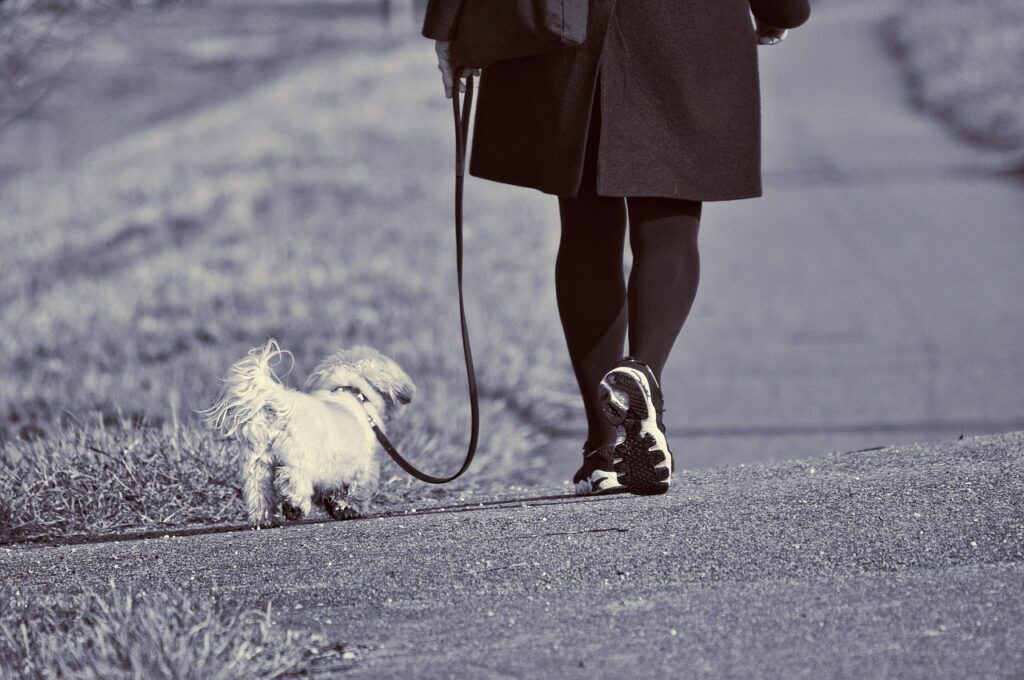
DOG WALKING · MEMBER JOURNEYS
Your dog already gets you out the door every day, rain or shine. With a few deliberate changes, those outings can become the most reliable workout in your week.
Dog walking has something most fitness plans lack: a companion who never cancels and who reminds you, loudly, when it is time to go. That built-in accountability is why dog owners tend to be more active than people without dogs. Yet a leisurely loop with plenty of stops does not always add up to exercise. This guide walks you through the stages of turning a daily obligation into a training habit, from checking your pace to building a weekly plan, adding strength and balance work, and staying safe on the leash.
Why dog walking is one of the easiest habits to keep
Consistency is the hardest part of any routine, and a dog solves much of it for you. In a 2019 study of households in West Cheshire, England, published in Scientific Reports, researchers including Carri Westgarth of the University of Liverpool estimated that dog owners were four times more likely than adults without dogs to meet the recommendation of at least 150 minutes of moderate-to-vigorous activity a week. In the same report, 64 percent of UK dog owners walked their dogs for at least 150 minutes a week, compared with 27 percent in a US study.
A separate study published in BMC Public Health in 2017 had men and women in their 60s and older wear small activity monitors around the clock. As NPR reported, dog owners walked an average of 22 minutes more per day than people without dogs, and they often walked briskly, at times around 3 miles per hour. Lead author Daniel Mills noted that the extra activity was not only longer but performed at a moderate pace.
Owning a dog has also been linked to longer life. A meta-analysis of 10 studies covering more than 3.8 million people, highlighted by the American Heart Association in 2019, found a 24 percent lower risk of death from any cause among dog owners. Those studies were not randomized, so they cannot show that the dog caused the benefit; fitter, healthier people may be more likely to own dogs. One of the researchers, Tove Fall, added an animal-welfare reminder: a dog should be acquired only by someone with the capacity and knowledge to give it a good life, which is a fair test to apply before adopting one in the name of fitness.
Is your daily walk brisk enough to count?
The CDC’s intensity guide lists brisk walking at about 2.5 miles per hour or faster as moderate-intensity activity. You do not need a speedometer to judge it. Use the talk test instead: at a moderate pace you can still talk, but you could not comfortably sing. If you can belt out a song, you are strolling; if you can manage only a few words between breaths, you have moved into vigorous territory.
Most dog walks fall short of moderate intensity not because the walker is slow but because the walk keeps stopping. Every sniff, greeting and investigation of a fire hydrant resets your heart rate. That is fine for your dog, and the sniffing has real value for them, but it means a 40-minute outing may contain only 15 minutes of continuous brisk walking. Our guide to walking for health explains why pace matters as much as distance.
Separate the sniff walk from the fitness walk
The simplest change is to give each part of the outing a job. Start with five relaxed minutes so your dog can sniff and settle, then switch to a steady, purposeful pace with a cue your dog learns over time, such as “let’s go.” Finish with a few easy minutes that double as your cool-down. You still meet your dog’s needs, and you protect a solid block of continuous walking for yourself.
- Choose a route with fewer distractions for the brisk portion, such as a park loop or a quiet street, and save the busy block for the slow finish.
- Add hills or stairs once the flat route feels easy; climbing raises your effort without requiring a faster pace from your dog.
- Use intervals. Alternate two minutes at a brisk pace with one minute of easy walking, a pattern most dogs adapt to readily.
- Keep a simple log of minutes and how hard each walk felt, so you can see progress instead of guessing.
A six-week plan to build your dog walking routine
Progress gradually, for your sake and your dog’s. The plan below assumes one main walk a day on most days, with the shorter outings your dog already gets left as they are.
| Weeks | Brisk walking per main walk | Days per week | Add this |
|---|---|---|---|
| 1 and 2 | 10 to 15 minutes | 5 | Separate sniff time from brisk time |
| 3 and 4 | 15 to 20 minutes | 5 | One route with a gentle hill |
| 5 | 20 to 25 minutes | 5 or 6 | Two-minute brisk intervals on one day |
| 6 | 25 to 30 minutes | 5 or 6 | Short strength and balance stops (below) |
By week six, five brisk 30-minute walks meet the weekly aerobic target on their own. If some days are rushed, two shorter brisk walks still count. What matters most is that the routine survives busy weeks and bad weather, which is where advice on staying active through winter comes in handy.
Add strength and balance along the route
Walking trains your heart and legs, but it does little for upper-body strength, and it rarely challenges balance in a deliberate way. Once your dog walks calmly beside you, you can build a few short stops into the route. Keep the leash secure and choose a moment when your dog is settled.
- Bench sit-to-stands: at a park bench, stand up and sit down slowly 8 to 10 times without using your hands.
- Step-ups: on a low, stable step or curb, step up and down 8 times with each leg, holding a railing if one is available.
- Calf raises: with a hand on a fence or railing, rise onto your toes and lower slowly 12 to 15 times.
- Incline push-ups: back at home, do 8 to 12 push-ups against a kitchen counter after you unclip the leash.
These additions take less than five minutes and turn a cardio habit into a more complete routine. Your dog effectively becomes a training partner who shows up every day, which is exactly the kind of support that helps people stay consistent.
Stay on your feet: leash safety
Dog walking carries one risk that a treadmill does not: a sudden pull. Researchers at Penn Medicine, writing in JAMA Surgery, found that fractures linked to walking leashed dogs among adults 65 and older rose from 1,671 cases in 2004 to 4,396 in 2017, an increase of 163 percent. Hip fractures made up 17 percent of cases, and women accounted for 78 percent. The authors emphasized that they were not discouraging people from walking dogs, only urging attention to fall risk.
- Hold the leash in your hand rather than wrapping it around your wrist or fingers, so you can let go if you are pulled off balance.
- Invest in basic leash training, or a session with a trainer, if your dog lunges at squirrels, bikes or other dogs.
- Wear supportive shoes with good grip, and slow down on ice, wet leaves and uneven pavement.
- Carry a light or wear reflective gear on dark mornings and evenings, and consider the same for your dog.
- Keep working on leg strength and balance off the leash; a steadier body handles a surprise tug far better.
When your dog, or your body, needs a different plan
Your dog’s age, breed and health shape how far and how fast it should go. Puppies, older dogs, short-nosed breeds and dogs with joint problems may need shorter or slower outings, especially in heat, so ask your veterinarian before you lengthen walks or pick up the pace. If your dog cannot keep up with the fitness portion, walk the brisk segment on your own and enjoy a gentler loop together later.
The same goes for you. Check with your doctor before stepping up your activity if you have heart disease, diabetes, kidney disease, osteoporosis, a recent fall, a joint injury or recent surgery, or if you are pregnant, and stop to get checked if walking brings on chest pain, unusual breathlessness, dizziness or calf pain. Once the routine feels automatic, our article on how long it takes to make exercise a habit may help you understand why it now feels easier to keep going.
THIS WEEK’S WALK CHECK
Five questions for your next outing
- How many minutes of continuous brisk walking did I get, not counting stops?
- Could I talk but not sing during the brisk portion?
- Did I give my dog relaxed sniff time at the start or the end?
- Was the leash in my hand, not wrapped around my wrist?
- Did I add one strength or balance stop, even a short one?
SOURCES AND FURTHER READING
American Heart Association via ScienceDaily · Dog Ownership Associated With Longer Life, 2019
Centers for Disease Control and Prevention · How to Measure Physical Activity Intensity
Penn Medicine · Bone Fractures Increasing as Seniors Walk Dogs to Stay Active (JAMA Surgery), 2019
This article is for general information and is not a substitute for personal medical advice.
Are you a fitness or wellness professional with a member journey to share?