


CALF RAISES · STRENGTH AFTER 40
Your calves launch every step, steady you on one foot and lift you up each stair, yet they rarely earn a place in a strength routine.
Calf raises are among the simplest exercises you can learn, and all you need is a wall or a sturdy chair. This guide explains what the calf muscles do, what research shows about ankle strength over the years, how to do the movement well, and how to progress from a small two-footed raise to a slow single-leg version.
What your calf muscles do with every step
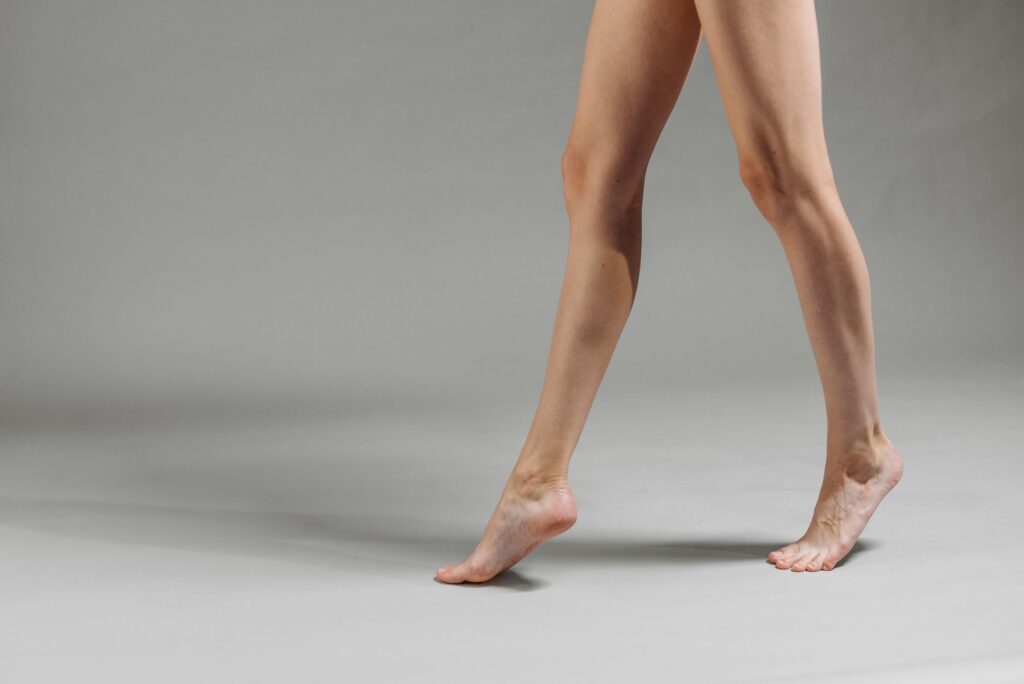
The calf is mainly two muscles. According to Cleveland Clinic, the gastrocnemius forms most of the visible bulk and crosses both the knee and the ankle, while the deeper, flatter soleus crosses only the ankle. The two join above the heel to form the Achilles tendon. StatPearls, a medical reference, describes the gastrocnemius as primarily active during explosive movements and the soleus as the muscle that predominates in sustained work such as standing or walking uphill.
Together they propel you forward when you walk or run and help stabilize the ankle, as Harvard Health puts it. That makes your calves the link between the floor and everything above it. Cleveland Clinic points out that a weak base can affect your knees and hips and change how you walk, and that weak ankles sprain more easily.
Why calf strength matters more as the years pass
Walking depends on push-off, the moment your calf drives your foot against the ground. A 2025 meta-analysis in the Journal of Biomechanics reported that a decline in strength in these muscles was associated with slower walking and less power at the ankle. A 2021 review in Gait & Posture likewise found less ankle movement at push-off in older adults, which its authors linked to age-related muscle loss, although most of the studies it included were rated poor to fair in quality.
Balance is the other reason to pay attention. In a study in Age and Ageing, calf strength was the only significant predictor of how far older adults could lean forward and remain stable. In a small Frontiers in Aging Neuroscience study, older adults who had fallen had about 30 percent less combined ankle strength than those who had not. That study captured one moment in time, in people around 79 years old, so it cannot show that stronger calves prevent falls. It does suggest that ankle strength is worth building early, alongside the habits in our guide to fall prevention.
A note of realism belongs here. Researchers writing in Wearable Technologies in 2022 observed that strengthening the calves alone has generally not improved push-off power or walking economy in older adults. Stronger muscles seem to help most when you use them in the movements you care about, so pair your calf raises with brisk walking, stairs and balance work.
How to do calf raises with good form
The basic movement follows the instructions from Harvard Health and Hospital for Special Surgery. Slow, full repetitions matter more than speed.
- Stand tall with your feet about hip-width apart, close to a wall or the back of a sturdy chair. Rest your fingertips on it for balance.
- Press through the balls of your feet and rise as high as you comfortably can, keeping your ankles from rolling outward.
- Hold at the top for about two seconds.
- Lower your heels slowly until they touch the floor, without bouncing.
- Breathe steadily, and let the next repetition start from a full stop.
Harvard Health suggests one to three sets of 8 to 12 repetitions. A physical therapist at Hospital for Special Surgery suggests 10 to 20 repetitions, every other day. Start at the lower end, and choose a version in which the last few repetitions feel like real work without any sharp pain.
Five calf raise variations, from easiest to hardest
| Variation | How to do it | When to use it |
|---|---|---|
| Small raise | Lift your heels only slightly while holding a wall or chair | When starting out or returning after a break |
| Seated raise | Sit with your feet flat and lift your heels, resting a weight on your thighs if you like | During long stretches at a desk |
| Full two-foot raise | Rise as high as you can with light fingertip support | As your main exercise for the first few weeks |
| Step-edge raise | Stand with your heels off the edge of a step, hold a banister, rise, then slowly lower | When you want a longer range of motion |
| Single-leg raise | Tuck one foot behind the other calf and rise on the standing foot | When 20 two-foot raises feel easy |
Because the soleus crosses only the ankle, a bent-knee raise shifts more of the work toward it. Seated versions drew attention after University of Houston researchers reported in iScience that a specific sustained movement they call the soleus pushup raised that muscle’s metabolism for hours. The researchers say the technique is hard to do correctly and that a simple way to teach it is still being developed, so treat seated raises as a useful break from sitting, not a metabolic fix.
To make any version harder, slow the lowering phase, as explained in our guide to eccentric training, or hold a dumbbell in one hand. Hospital for Special Surgery suggests building up to two or three sets of 10 for its eccentric version. Single-leg work also challenges balance, so our single-leg exercises make a natural next step.
How often to train your calves
You do not need a separate calf day. The American College of Sports Medicine’s 2026 resistance training position stand emphasizes training all major muscle groups at least twice a week and recommends two to three sets per exercise for strength. It also stresses that consistency matters more than chasing a perfect plan. Calf raises fit neatly at the end of a full-body dumbbell workout or alongside your regular leg exercises.
A simple progression might be two sets of 10 for the first two weeks, then three sets of 12, then a harder variation at two sets of 8. That is progressive overload in its plainest form: when the current version feels easy, change one thing.
A simple heel-raise check
Clinicians sometimes measure calf strength by counting how many heel raises a person can do. A 2022 review of 13 studies found that adults under 40 averaged about 29, while adults over 60 averaged about 12. Its author cautioned that older adults should not be expected to reach the 25-repetition benchmark once proposed as normal. Test procedures varied considerably, so use your count as a personal baseline rather than a grade.
Pick one setup and stick with it: same spot, same fingertip support, same full height on every repetition. Count until you can no longer rise fully, test each leg separately if you can, and repeat the test every month or two.
When to ease off and protect your calves
Calf strains are common in active adults. Harvard Health explains that “tennis leg” is a strain, usually of the gastrocnemius, that can happen when you plant your foot hard, stop suddenly or change direction. Older athletes are especially prone, and the article warns that 20 to 30 percent of people strain the calf again if they skip proper treatment. A thorough dynamic warm-up is a sensible habit before court sports or fast walking.
Stop if you feel a sudden pop or sharp pain, and rest a sore Achilles tendon instead of pushing through it. Get prompt medical care for swelling, warmth or redness in one calf, because those signs can point to a blood clot. Medical advice also comes first if heart disease, diabetes or kidney disease is part of your history, or if you are pregnant, injured, recovering from surgery or noticing new symptoms. If your feet or ankles feel stiff during the movement, our guides to ankle mobility and foot strength can help.
TWO-MINUTE CALF SESSION
Add this to your next two strength days
- Do 10 slow two-foot raises, pausing for two seconds at the top.
- Rest for 30 seconds, then do 10 more.
- Walk 10 steps forward on your toes and 10 steps back, then do the same on your heels, a drill Harvard Health recommends.
- Write down your repetitions and how the last few felt.
SOURCES AND FURTHER READING
Cleveland Clinic · Calf muscle: anatomy, function and common conditions
StatPearls · Anatomy, bony pelvis and lower limb: calf · NCBI Bookshelf
Harvard Health Publishing · Building stronger legs
Cleveland Clinic · Ankle strengthening exercises for weak ankles
Hospital for Special Surgery · Ankle stretches and exercises for strength, from a PT
Harvard Health Publishing · What to do if you get “tennis leg”
University of Houston · Discovery unlocks potential of “special” muscle · 2022
This article is for general information and is not a substitute for personal medical advice.
Are you a fitness or wellness professional with a member journey to share?