HOME GYM · ACTIVE LIVING
You want to train more often, but the drive to the gym, the crowded hours and the monthly fee keep getting in the way. A small, well-chosen setup at home can remove most of that friction.
A home gym does not need a spare room or a big budget. It needs the right few pieces, a spot where they live, and a weekly plan that tells you what to do when you walk in. This guide covers how much space you really need, which equipment to buy first and in what order, what the research says about bands versus weights, and a sample week that meets national activity guidelines.
Why a home gym can work better than a membership
The strongest argument for training at home is consistency. The American College of Sports Medicine’s 2026 position stand on resistance training, an umbrella review of more than 137 studies with data from over 30,000 participants, puts it plainly in its summary for the public: “The best resistance training program is the one you will actually do.” The same summary notes that the biggest jump in results comes from going from no resistance training to any resistance training.
That matters because the real competition for your workout is rarely another program. It is the commute, the weather and the half hour you lose finding parking. When the equipment is ten steps away, a twenty-minute session before dinner becomes realistic. The ACSM summary also states that elastic bands, bodyweight exercises and home-based training are effective options, and that choosing machines or free weights did not consistently change results.
The weekly targets stay the same wherever you train. The federal Physical Activity Guidelines for Americans call for 150 to 300 minutes a week of moderate-intensity aerobic activity, or 75 to 150 minutes of vigorous activity, plus muscle-strengthening work for all major muscle groups on two or more days a week. A home gym makes the strength part far easier to hit.
Find the space you already have
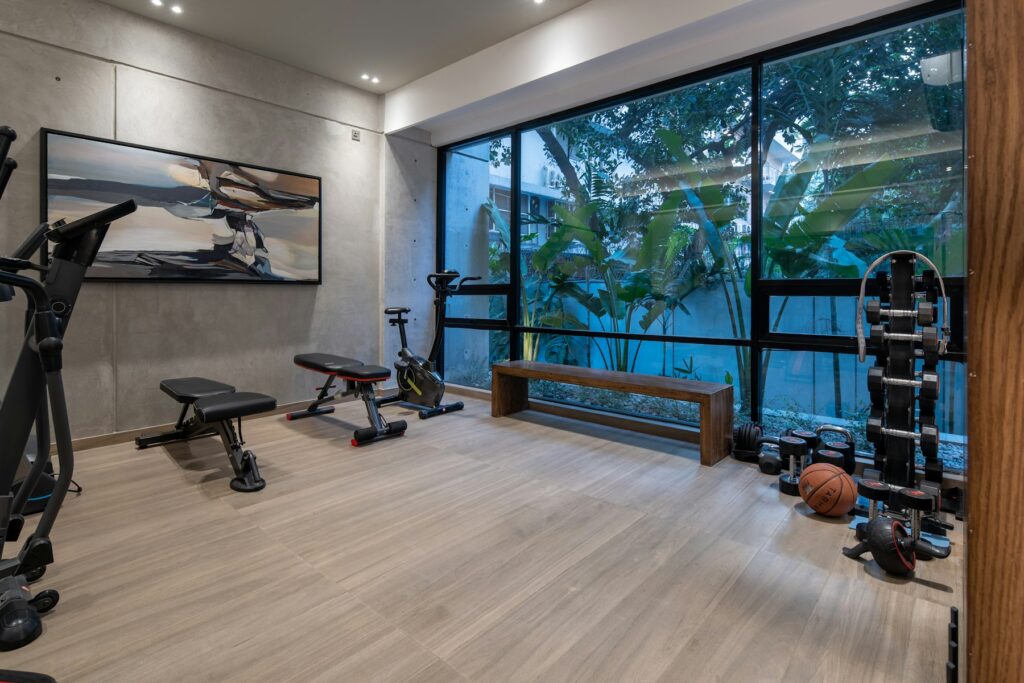
Before buying anything, choose the spot. A corner of a bedroom, a section of the garage, a basement nook or the end of a living room can all work. Stand in the space and run through the moves you plan to do: lie down with your arms overhead, step forward into a lunge, press a pair of imaginary dumbbells toward the ceiling and swing your arms out to the sides. If you can do all of that without touching a wall, a lamp or furniture, the space is large enough for most beginner and intermediate programs.
- Floor: a firm, level surface with a mat or rubber flooring protects both you and the floor, especially if you set weights down.
- Air and light: a window, a fan or a heater makes the difference between a space you enjoy and one you avoid in July or January.
- Storage: a low rack, a sturdy shelf or a bin keeps weights off the floor and bands untangled, so setup takes seconds.
- Visibility: equipment you can see is equipment you use. If it lives behind a closed closet door, it tends to stay there.
Home gym equipment to buy first, in order
The most common home gym mistake is buying a large machine first and discovering it covers only a few exercises. A better approach is to build in stages, starting with versatile, compact tools that let you train every major movement pattern: squatting, hinging, pushing, pulling, lunging and carrying. Add the next stage only once you are using the current one regularly.
| Stage | Equipment | What it lets you do |
|---|---|---|
| 1. Foundation | Exercise mat, a set of resistance bands with handles and a door anchor, a sturdy chair | Rows, presses, squats to a chair, glute bridges, floor core work and mobility |
| 2. Free weights | Two or three pairs of dumbbells, or one pair of adjustable dumbbells | Goblet squats, Romanian deadlifts, one-arm rows, presses, lunges and carries |
| 3. Support | A flat or adjustable weight bench | Supported rows, chest presses, step-ups and a stable base for seated work |
| 4. Variety | A kettlebell, a suspension trainer or a doorway pull-up bar | Swings, deadlifts, inverted rows and assisted pulling |
| 5. Optional | A cardio machine, a power rack or heavier plates | Indoor aerobic work in bad weather and heavier progressive loading |
Choose dumbbell weights that let you finish a set of about 10 repetitions with good form while the last two feel hard. Most people need a lighter pair for shoulders and arms and a heavier pair for legs and back. Adjustable dumbbells save space and grow with you, while fixed pairs are quicker to grab between exercises. If you are not sure where to start, our full-body resistance band workout can be done with stage one equipment alone.
Bands or weights? What the evidence says
Many people assume bands are a lesser substitute for metal. The research suggests otherwise. A 2019 systematic review and meta-analysis in SAGE Open Medicine pooled eight studies comparing elastic resistance training with conventional resistance training and found similar strength gains, with no significant difference for either upper- or lower-body strength across different groups and protocols.
A May 2026 Harvard Health review of the new ACSM guidance reached the same practical conclusion, describing home workouts built on bodyweight movements and bands as just as effective as gym equipment. The real difference is convenience and feel. Bands are light, cheap and easy to store, and they are kind to sensitive joints. Dumbbells make it easier to see your progress in pounds and to load lower-body moves heavily. Most home gyms end up using both.
Whatever you choose, the principle that drives results is the same: gradually ask your muscles to do a little more over time. That might mean more repetitions, a heavier dumbbell, a thicker band or an extra set. Our guide to progressive overload explains how to do that without rushing.
A simple week in your home gym
The ACSM summary recommends training all major muscle groups at least two days a week and building gradually. For strength, it suggests two to three sets per exercise, and for muscle growth, a higher weekly volume of about 10 sets per muscle group. It also notes that pushing every set to momentary muscle failure did not consistently change results for the average healthy adult, so you can stop a rep or two short and still progress. Here is one way to put that together with aerobic work.
| Day | Session | Approximate time |
|---|---|---|
| Monday | Strength A: goblet squat, one-arm row, push-up or chest press, glute bridge, plank | 30–40 minutes |
| Tuesday | Brisk walk or cycling at a conversational effort | 30–45 minutes |
| Wednesday | Mobility and balance: hips, upper back, single-leg stands | 15–20 minutes |
| Thursday | Strength B: Romanian deadlift, split squat, band pull-apart, overhead press, carry | 30–40 minutes |
| Friday | Brisk walk, hike or a class you enjoy | 30–45 minutes |
| Saturday | Longer outdoor activity or an optional third strength session | 45–60 minutes |
| Sunday | Rest or an easy stroll | As you like |
For each strength exercise, start with two sets of 8 to 12 repetitions and add a third set once the movement feels familiar. Begin every session with a few minutes of marching in place, arm circles and lighter practice sets. Strength training appears to pay off beyond muscle, too: Harvard Health has reported on a study that linked about one hour a week of strength training with a lower risk of heart attack, stroke and death from heart disease, compared with none.
Habits that keep the equipment in use
Equipment does not create a habit on its own. What makes a home gym stick is lowering the effort it takes to start. Keep a mat unrolled or within reach, leave the bands on a hook, and post the week’s plan where you will see it. Decide the time of day in advance, the way you would book a class, and protect it.
Tracking helps more than most people expect. Writing down the exercises, weights and repetitions turns each session into a small, visible step forward. A simple workout log is enough. On low-energy days, use a minimum rule: put on your shoes and do one set of each exercise. Most of the time, you will keep going, and on the days you do not, the habit still holds.
Safety basics for training at home
Training alone at home means you are your own spotter, so set up for safety. Keep the floor clear of cords, toys and pets during sessions. Check bands regularly for nicks or thinning and replace them at the first sign of wear, and make sure any door anchor sits in a sturdy door that is fully closed. Store dumbbells low so you never lift them from overhead shelves, and choose loads you can control on the last repetition.
Talk with your doctor before starting or intensifying training if you have heart disease, diabetes, kidney disease, high blood pressure, a recent injury or surgery, are pregnant, or notice new symptoms such as chest discomfort, unusual breathlessness or dizziness. The national guidelines advise that adults with chronic conditions or symptoms should be under the care of a health care provider, and they also offer an encouraging reminder: some physical activity is better than none.
YOUR HOME GYM CHECKLIST
Set up your space this week
- Pick one spot and test it by lying down, lunging and reaching overhead.
- Buy stage one equipment: a mat, bands with handles and a door anchor.
- Schedule two strength sessions and two walks on your calendar.
- Start a log and record every set for the first four weeks.
- Add dumbbells once you are training twice a week without missing.
This article is for general information and is not a substitute for personal medical advice.
Are you a fitness or wellness professional with a member journey to share?